Cracked apples and bland grapes: Climate change reshapes Korean farms and dinner tables
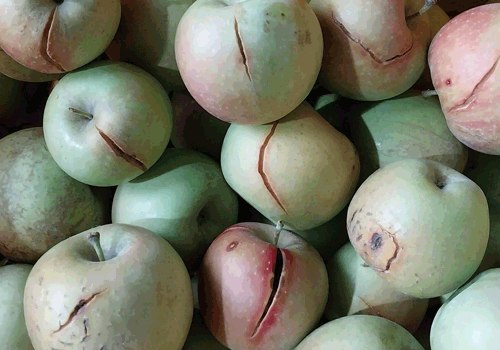
Cracked apples show the effects of splitting damage. Repeated heat waves and heavy rain weaken the skin, causing water-soaked fruit to burst. Courtesy of Yoon Young-hwan
In a small orchard in Jangseong County, South Jeolla Province — the southernmost region where apples grow in Korea — farmer Yoon Young-hwan has spent more than half a century tending his trees. But in the past few years, he has witnessed something he never saw before in 53 years of apple farming: perfectly ripened fruit suddenly cracking wide open.
"If I had 100 apples last year, about 80 split open. This year I tried everything I could to prevent it, but still about 60 percent cracked," said Yoon, 83. "We call this 'yeolgwa.' When I started farming apples in 1972, this concept didn’t even exist."
Fruits splitting in the heat
The phenomenon occurs when fruit absorbs water too quickly due to extreme weather shifts — from scorching heat waves to sudden heavy downpours. The fruit’s skin cannot keep pace with the rapid growth, causing it to split. Even when the skin remains intact, prolonged exposure to intense sunlight can cause apples to turn yellow and spoil.
Rising spring temperatures also cause blossoms to bloom earlier, leaving them vulnerable to sudden cold snaps. Some farmers have tried building 4-meter-high shade structures to protect their crops from sun damage, but the cost — about 100 million won ($73,000) per 3,300 square meters — is often prohibitive.
Local authorities have encouraged farmers to switch to subtropical crops like lemons or apple mangoes, but Yoon said the transition is not so simple. "Growing subtropical fruit requires greenhouse facilities, and those cost a lot of money," he said.
Apple fields disappearing by 2090
According to the Rural Development Administration, apple cultivation — which thrives in cooler climates with average annual temperatures of 7.5 to 11.5 degrees Celsius — is likely to vanish from Korea by the end of the century. In the worst-case scenario, where fossil fuel dependence continues, only 1.1 percent of existing farmland will still be suitable for apples by the 2070s, falling to the zero percent range by the 2090s.
Other crops face similar threats. Pear-growing regions could shrink from 89.8 percent to 30.1 percent, while peach cultivation zones could decline from 82.2 percent to 29.9 percent. Ginseng farmland — currently 84.1 percent of total farmland — may fall to just 9 percent in 50 years.
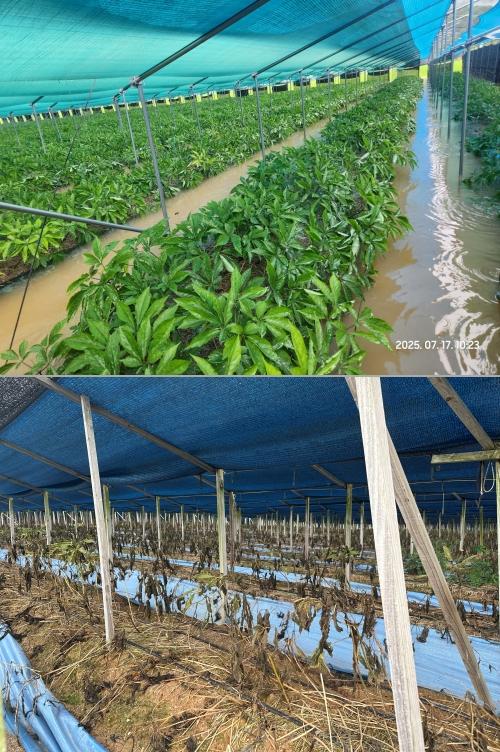
A ginseng field is submerged during heavy rainfall in July (top), while ginseng plants wither and die under extreme heat. Courtesy of the Korea Ginseng Association
"The heat wave usually ends by mid-August, but since 2020, we’ve seen 30-degree weather lasting into mid-September," said Kim Myung-soo, head of the Korea Ginseng Association, who has farmed ginseng for 25 years. "I haven’t seen weather like this since the 1994 heat wave." Ginseng, which takes six years to grow and requires low light, is particularly vulnerable to extended periods of high temperatures, which slow its growth. Kim said that as a result, about 15 percent of ginseng has little commercial value.
By contrast, the warmer climate is expected to benefit subtropical fruits. Farmland suitable for hallabong citrus could rise from 0.6 percent to 12.9 percent, and for tangerines from 1.2 percent to 34.6 percent.
Grapes lose sweetness as nights stay hot
Climate change is also altering the taste of fruits. A 2021 study by the National Institute of Horticultural and Herbal Science found that Kyoho grapes grown at night temperatures above 24 degrees Celsius had lower sugar content and failed to ripen properly, turning pale instead of deep purple. Extended tropical nights — when temperatures remain high after sunset — now affect not just humans but fruit, too.
Changing weather patterns are also transforming the varieties available to consumers. A report by the National Agricultural Cooperative Federation last November showed that while the Fuji apple still accounted for 52 percent of total shipments in 2023, its output dropped by 31 percent from the previous year. Meanwhile, new varieties are rapidly expanding. Shipments of Shinano Gold, a yellow-skinned apple, grew from just 0.5 tons in 2018 to 2,920 tons in 2023.
Beyond adaptation: Protecting the dinner table
Will consumers simply have to accept that familiar crops are disappearing and adapt their palates to new subtropical fruits? Experts say mitigating global warming is also a way to protect Korea’s traditional diet. Under a low-emissions scenario, 16.2 percent of farmland would remain suitable for apples in the 2070s — a dramatic difference from the 1.1 percent forecast under the worst-case scenario.
Experts warn that assuming farmers can easily adapt to shifting conditions is misguided. "You can’t just plant anything in a region with cooler temperatures," Kim said. "Soil in fields used for highland vegetables for a long time is often too polluted for ginseng."
Switching crops is also far from simple. "Changing crops is like changing careers," said Choi Woo-jung, a professor of regional biosystems engineering at Chonnam National University. "It’s like asking a baker to start making cars because they’re both part of manufacturing."
Efforts to prevent price spikes by increasing agricultural imports must also go hand in hand with policies that support farm income. "It’s frustrating to hear about importing apples when we can’t even grow them properly," Yoon said. "The entire apple industry could collapse."
Choi added, "We need to address rising food prices, but we also need policies like pilot basic income programs for rural communities so that farmers have the capacity to adapt."
This article from the Hankook Ilbo, the sister publication of The Korea Times, is translated by a generative AI system and edited by The Korea Times.