Gyeonggi to inject $2.3 billion into forest projects to absorb carbon emissions

Gyeonggi Province Governor Kim Dong-yeon speaks during a press conference at the headquarters of the provincial government in Suwon, Gyeonggi Province, July 12. Newsis
Governor also plans to launch new renewable energy data center
By Ko Dong-hwan
The government of Gyeonggi Province is set to invest 3.1 trillion won ($2.3 billion) in reducing local carbon emissions by turning more regions within its jurisdiction into wooded areas and building a new data center to better monitor the province's power grid.
The initiative is aimed at meeting the country's national goal of reaching carbon neutrality by 2050, according to the provincial authority, Monday.
The provincial government's latest environmental goal will increase the carbon-absorbing capacity of local forests when compared with the total local output of carbon emissions produced by the province.
In 2020, the government estimated that the province's local forests absorbed about 1.4 million tons of carbon emissions. The authority also estimated the province's overall carbon emissions by the end of that year to be close to 63 million tons.
Under the new forestation project, the authority aims to absorb 1.5 million tons of carbon emissions by 2030. The authority expects that by then, the province's overall carbon emissions will be lowered to 52 million tons. By 2050, the authority expects the local forests to absorb 1.6 million out of 9.5 million tons of local carbon emissions.
In 2020 Gyeonggi forests absorbed emissions equivalent to 2.2 percent of the province's total carbon emissions. By 2030 the forests will absorb 2.8 percent of the total and by 2050, almost 17 percent of the total.
The provincial government's plan coincides with plans of the Korea Forest Service, which has been monitoring how much the country's national forests are reducing carbon emissions. The agency says that each hectare of forest can absorb 6.4 tons of carbon emissions per year.
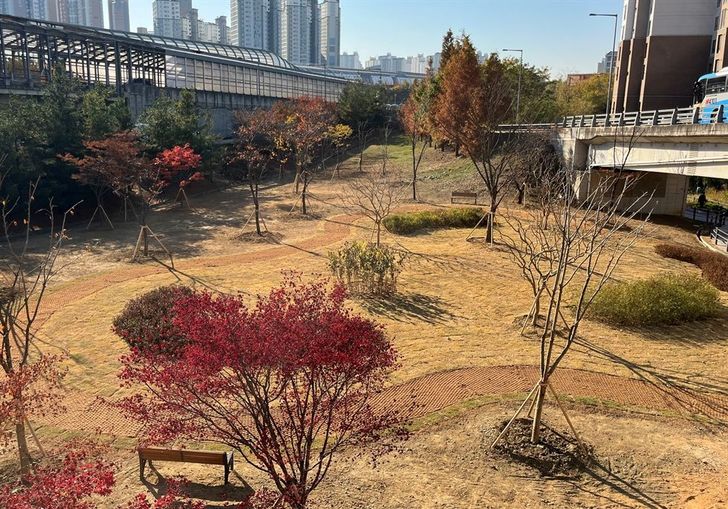
A new city tree park in Yongin, Gyeonggi Province, Dec. 1, 2022 / Courtesy of Yongin Special City
The forest agency said that in 2020, the country's national forests absorbed over 40 million tons of carbon emissions nationwide. Alongside the central government's carbon neutrality initiatives expected to expand, the agency anticipates that the country's local overall foliage will absorb over 25 million tons of carbon emissions by 2030 and almost 24 million tons by 2050.
The central government has set a goal to reduce the country's overall carbon emission by 40 percent of the levels reached back in 2018 by the end of 2030 ― and further reduce emissions to zero by 2050.
The provincial authority said that they will carry out some 60 projects to accomplish the goals. The projects include planting firebreak forests at the foot of local mountains, building more wooden buildings to neutralize carbon emissions and introducing trees that have been proven as super absorbers of carbon.
Within the same environmental initiative, the provincial government also plans to establish a new data portal, which will show comprehensive real-time information on how much carbon emissions and greenhouse gases have been emitted throughout the province, how much has been reduced, as well as how much power has been purely generated by renewable energy-based power plants.
The Gyeonggi RE100 Platform initiative, according to the authority, will contribute to monitoring the provincial government's carbon reduction energy policies. The platform will also help the authority plan possible locations for new solar farms, plan new policies to fend off the climate crisis, as well as minimize local damage from extreme heat waves and downpours.
The authority is injecting 17.5 billion won to build the platform that Governor Kim Dong-yeon promised last April.
The provincial government aims to supply all local firms with power generated by renewable energy-based plants by 2050.