Gov't slammed for leniency on Fukushima wastewater release

A civic group stages a rally in front of the Japanese Embassy in Jung District, Seoul, Wednesday, in protest of Japan's plan to start releasing treated radioactive wastewater from its Fukushima Daiichi Nuclear Power Plant on Thursday. Yonhap
By Nam Hyun-woo
The Korean government's measures for monitoring Japan's planned release of treated radioactive wastewater from the Fukushima Daiichi Nuclear Power Plant are drawing criticism, as Seoul has compromised on initial demands to ensure the safety of its people.
The government is promising to “double and triple its efforts to prevent any adverse impact on public health.” But civic groups and the opposition expressed more concern and doubts on Wednesday, a day before Tokyo's planned release of the wastewater begins.
The government, Tuesday, announced a series of agreements with Japan addressing Korea's safety concerns. The two sides have been consulting with each other over this issue since the summit between President Yoon Suk Yeol and Japanese Prime Minister Fumio Kishida last month.
The Korean government had initially asked for a series of monitoring measures, including having Korean experts stationed at the release site. However, a proposal by the International Atomic Energy Agency (IAEA) was accepted instead, allowing Korean experts to visit the site regularly but not to be permanently stationed there.
“We understand that it is difficult to have Korean experts stationing at the site, given the (issue of) fairness with other countries and other projected consequences,” said Park Ku-yeon, the first deputy chief of the Office for Government Policy Coordination.
“The government believes the IAEA's proposal is an effective monitoring measure, comparable to dispatching experts. We think this is a gesture of good faith from Japan and we have no plans to further raise the issue of having experts stationed (there).”
The compromises reached between Korea and Japan include setting up "communication hotlines" and Japan's promise to publish release-related data every hour online. However, concerns remain about how often Korean experts will be able to visit the site and the extent of their monitoring ability.
Along with dispatching Korean experts, only two out of four technical stipulations that the Korean government delivered to Japan were agreed upon.
Of them, Japan promised to plan with Korea's demands; for re-conducting radiation assessments in the case of changes in source terms (types and amounts of radioactive material released to the environment following an accident); and assessing residents' radiation exposure based on actual nuclide emissions.
However, Tokyo postponed discussions on shortening the period of the inspection cycle of the Advanced Liquid Processing System (ALPS) filters and adding five additional radionuclides for the annual concentration measurements of the ALPS inlet and outlet.
Despite the compromises, Park said, “We have secured an effective and multi-layered monitoring system meeting Korea's demands.”
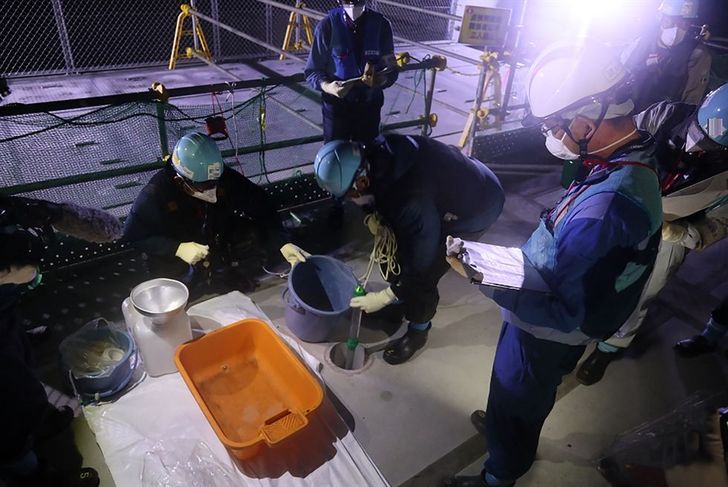
Employees of Tokyo Electric Power Company (TEPCO) check samples of wastewater from the Fukushima Daiichi Nuclear Power Plant, Tuesday, with wastewater release set to begin Thursday. Courtesy of TEPCO
Seoul's handling of the situation stands in contrast to China's more aggressive response.
On Tuesday, China's foreign ministry summoned a Japanese envoy and complained that “the release is very selfish and irresponsible behavior, prioritizing Japan's own interests over the long-term well-being of the world.” The ministry also threatened to make “necessary measures to preserve the maritime environment and food safety.”
On Wednesday, the China Coast Guard announced that its “vessel fleet 2502 conducted a patrol within the territorial waters of the Diaoyu Islands, which is within China's legal rights for safeguarding activities.” The Diaoyu, or Senkaku, Islands are a group of uninhabited islands in the East China Sea subject to territorial disputes between Japan and China.
Against this backdrop, Korean civic groups held multiple protests across the country to denounce Japan's release plan and the Korean government's lenient responses.
“The Korean government has not clearly stated its stance on whether it opposes the release or not,” Joint Action to Prevent Fukushima Contaminated Water, a federation of domestic environmental civic groups, said in a statement. “With Japan about to release the contaminated water, the public is unable to know about how our government sees the situation.”
The main opposition Democratic Party of Korea (DPK) is also concentrating its efforts on deterring the release itself, with its chief likening the release to “the second Pacific War.”
“Japan, which threatened the survival of neighboring countries through imperialistic invasions, is once again attempting to bring irreversible disaster to Korea and Pacific coastal nations through the release of nuclear-contaminated water,” DPK Chairman Lee Jae-myung said, Wednesday.
“Japan's Fukushima contaminated water release will be recorded as the second Pacific War.”
Citing a Japanese media report that Korea requested Japan to release the water before it affects the general election in April next year, Lee also said that “I can predict that the government will say around April that there is no contamination.”
DPK floor leader Park Kwang-on claimed that President Yoon should reveal the government's clear stance and plans through a press conference, saying “The people have the right to know what the government's opinion was on the Fukushima water release plan during the recent trilateral summit between Korea, the United States and Japan.”
In response to intensifying criticism, Prime Minister Han Duck-soo said, also on Wednesday, that the government will be ready to file an international lawsuit if Japan's release of treated radioactive wastewater from the crippled Fukushima nuclear power plant deviates from the original plan.
"The Ministry of Foreign Affairs will always remain ready to lodge a suit internationally if the release is conducted in a way that is inconsistent with standards," the prime minister said during a press briefing in Sejong.
He added that Korea will also demand an immediate halt of the release in the event that the concentration level of even a single nuclide goes beyond acceptable levels.