Seoul expands forests to introduce wind paths for cleaner air

Trekkers climb Mount Bukan in Seoul, October 2017, with the city seen behind the mountain. Korea Times file
Second project aims to boost number of trees planted in 1st phase
By Ko Dong-hwan
The Seoul metropolitan government plans to expand the size of forested areas in the sprawling capital by 2025.
The latest project is the city government's second bid to make the air in the metropolis cooler and cleaner by expanding forested areas. The first phase of the project was completed in 2021.
The main goal of the project is to create so-called wind paths consisting of trees that connect the mountains outside of Seoul to the city's inner regions dotted with buildings. According to the city government, fresh air generated from the mountains can be carried down to the inner city that often suffers from trapped heat, resulting in a lowering of temperatures and air pollutants.
The second project expands the number of trees planted in the first phase in two city zones ― from Mount Gwanak to Anyang Stream in southern Seoul, and from Mount Bukan to Ui Stream in northern Seoul. Starting this month, planning for the second project began and will be followed by the tree planting process during 2024-25.
With 5 billion won ($3.76 million) in central government funding and another 5 billion won from the Seoul Metropolitan Government, the second project will introduce new trees in 11 city districts amounting to 7.3 hectares. In the first phase, over 540,000 trees were planted in 6 city districts. The first wind paths were created on more than 189 hectares of land in the capital.
According to the Environmental Planning Bureau under the city government's Climate and Environment Headquarters, there are three different types of wind paths. “Wind generating forests” indicate mountains where the paths scoop up the clean air. “Path forests” act as a pipeline of trees (alongside streams, for example) between the mountains and the inner-city. “Expansion forests” spread the clean air delivered from the mountains throughout the city through parks, forested buildings and other trees in public facilities like schools.
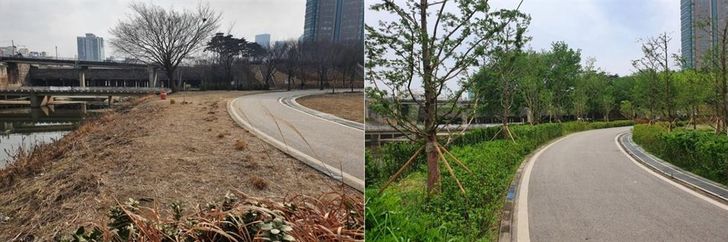
Ui Stream in northern Seoul, previously a barren land, left, is now forested with trees. The trees form one of the wind paths which extends from Mount Bukan in northern Seoul. Courtesy of Seoul Metropolitan Government
Seoul has a unique geographical setting that is ideal for wind path forests, according to the city government. Its outskirts are surrounded by large mountains like Mount Gwanak to the south and Mount Bukan and Mount Dobong to the north, while the Han River flows horizontally through the core of the capital with smaller streams branching out. The city government said that after sunset, cool air from the mountains can spread through wind path forests and settle in the urban communities.
To figure out the ideal locations for the city's wind paths, Seoul employed a two-dimensional simulation model called KLAM_21 developed by the German Meteorological Service for calculating cold air flows in mountainous terrains. During the planning phase for the first wind path forestation project, the city government employed the German model to decide where to lay out the tree paths.
The temperature mitigating and air purifying effects of trees have been proven by the state forest research agency.
The National Institute of Forest Science (NIFS) said a forest measuring 1 hectare in area with trees 10 years or older can lower almost 7 tons of carbon dioxide and absorb almost 170 kilograms of air pollutants each year. They further lead to lowering the peak daytime temperatures during summer by three to seven degree Celsius and increasing humidity by 9 to 23 percent, helping mitigate domes of heat hovering over the metropolis.
A 2021 study by NIFS proved that Hongneung Forest in Dongdaemun district of northeastern Seoul lowers the region's PM10 (particulate matters with a diameter of 10 micrometers or less) level by 26 percent and PM2.5 by 41 percent.
The city government said the latest environmental project will contribute to realizing the Paris Agreement from 2015, which prompted 195 United Nations member states to launch environmental initiatives to lower global greenhouse gases and slow down global warming. The Seoul government said city forestation is one of the key strategies to tackle those problems.