High humidity meets dry air to feed extreme downpour: weather agency

Paddy fields in Haenam County, South Jeolla Province, are flooded, Sunday. Yonhap
Chungcheong, Jeju forecast to see up to 300 mm through Wednesday
By Ko Dong-hwan
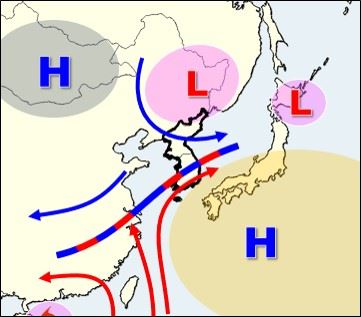
A seasonal stationary front is formed above the Korean Peninsula between the North Pacific High, bottom right, and the Tibetan anticyclone, top left, and low atmospheric pressure in this graphic image by the Korea Meteorological Administration released Monday.
An intensified stationary front jointly fed by high humidity from the south and dry air from the north has generated the severe downpours that have so far left 50 people dead or missing and caused landslides and flash floods over the weekend, according to the country's top weather watchdog, Monday.
High humidity from the North Pacific High, a semi-permanent subtropical anticyclone, moved up from the country's south and met a cool, dry air current that penetrated south between low atmospheric pressure and the Tibetan anticyclone.
That collision of weather systems has activated more rigorously the stationary front that forms every summer over the country for weeks triggering monsoon downpours, according to the Korea Meteorological Administration (KMA).
“Compared to their average intensity from the previous years, the anticyclones this year grew unusually stronger,” Woo Jin-kyu from the KMA told The Korea Times.
“For one thing, the North Pacific High that acts like a pump that draws up warm, humid air has apparently become more active. That excessive strength has generated a much greater amount of humidity. That was the same with the Tibetan anticyclone, resulting in an out-of-proportion build-up of the stationary front.”
Woo dismissed the theory that warming ocean surfaces caused by global warming may have contributed to the extreme downpour. He said such an effect is now rather limited to the subtropical regions in the 20-degree range of the equator, much further south of the Korean Peninsula.
The stationary front that lies across the Korean Peninsula is forecast to remain close to the country until Wednesday morning before starting to fade away to the south.
North and South Chungcheong provinces in the country's central regions as well as North Gyeongsang and North Jeolla provinces in the lower parts of the country are directly under the influence of the stationary front's torrential downpour.
Until Wednesday morning, those regions will see hourly precipitation of 30 to 60 millimeters and in some areas up to 80 millimeters. Jeju Island, from today until early Wednesday, will also be affected by the stationary front, seeing up to 100 millimeters of rain per hour.
Chungcheong, southern regions and Jeju Island will see record amounts of accumulated precipitation from Monday to Wednesday, according to the KMA.
The regions will see at least 100 millimeters and up to more than 300 millimeters. The mountainous regions around Mount Halla on Jeju will see the most rain in the country with more than 500 millimeters forecast ― which is feared to cause landslides. The mainland's southern coasts and the high grounds around Mount Jiri in South Jeolla and Gyeongsang are also expected to see more than 400 millimeters each.
The capital region and low grounds in Gangwon Province will be less affected, seeing less than 60 millimeters until Wednesday morning. Southern Gyeonggi Province and the mountains in Gangwon, as well as Ulleung Island and Dokdo, will see precipitation of 30 to 100 millimeters during the same period.
This year's monsoon downpour has proven to be more devastating than previously notable records as the worst impact has been seen nationwide whereas in the past it was limited to certain regions.
The extreme downpour in 2011 dealt significant devastation in the country's capital region of Seoul, Incheon and Gyeonggi as well as Gangwon where over 300 millimeters of accumulated precipitation were recorded in each region. The same floods were seen in the same regions in August 2022 and in September 2022 in Gyeongsang provinces and Jeju Island when Typhoon Hinnamnor dealt its heaviest blows.
This year, the 300-millimeter-plus extreme downpour soaked the entire country with the exception of South Gyeongsang Province.