Torrential rain to hit greater Seoul area Tuesday

Pedestrians holding umbrellas cross a road in Busan, Monday, as the annual monsoon season starts. Yonhap
Gov't enters emergency response mode as monsoon season begins
By Lee Hae-rin
Seoul and its surrounding areas are forecast to see up to 100 millimeters of heavy rain with a chance of thunderstorms for two days until Tuesday as the annual monsoon season has begun, the state weather agency said Monday.
The Korea Meteorological Administration (KMA) said the country will see heavy showers from Monday to Tuesday, with Seoul forecasted to receive 40 millimeters to 100 millimeters of rain per hour during the daytime.
The national weather forecast agency issued heavy rain warnings for Jeju Island and southern provincial areas, Sunday, and expanded the forecasts to South Chungcheong Province and North Jeolla Province on Monday morning.
The areas surrounding Seoul and inland areas of Gangwon, Chungcheong and North Gyeongsang provinces saw 20 millimeters to 40 millimeters of rain per hour by Monday night while rural southern regions and Jeju Island were expected to receive as much as 60 millimeters of rain by Tuesday morning, the KMA said.
The KMA expects the nation to see a brief lull in the rain Tuesday afternoon, but heavy downpours are forecast to resume on Wednesday and continue through Saturday.
Meanwhile, the government went into a 24-hour emergency response mode nationwide to monitor for damage caused by torrential rains, Monday.
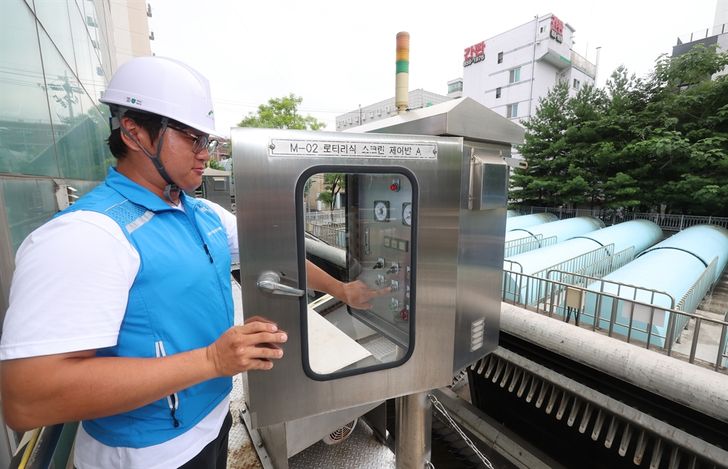
An official inspects a rainwater pump station in Seoul's southern Gwanak District to prepare for heavy rain as the annual monsoon season begins, Monday. Yonhap
The Ministry of the Interior and Safety issued Level 1 of the three-tier natural disaster alert system early Monday morning at 3 a.m. to monitor for possible damage from the torrential rain.
The ministry issues Level 2 when the national weather agency announces a warning against upcoming heavy rain or a typhoon, and lifts it to Level 3 in case heavy downpours continue for three days after the warning is announced and large-scale damage is expected.
In addition, the government, led by the safety ministry, launched a taskforce three weeks ago to coordinate damage control operations.
Plus, the ministry ordered thorough preliminary steps for speedy evacuation in the event of flooding in semi-basement housing or underground parking lots, while providing extra assistance to those who are more vulnerable to natural disasters, such as people with disabilities and senior citizens living alone.
As heavy rain soaked the capital overnight, the Seoul Metropolitan Government secured public access around four streams in the city ― Cheonggye, Seongbuk, Jeongneung and Ui streams, Monday morning. The KMA warned against using streamside trails, citing the dangers of flash-flooding.
On Sunday, the city government cleaned 67,282 street drains across the capital to prevent stormwater blockages in the city center, which was blamed for flooding around Gangnam Station last August.