Animal rights groups call for protection of retired racehorses

In this picture taken by People for Ethical Treatment of Animals (PETA) investigators on Nov. 12, 2018, retired racehorses are whipped by a man before being killed at a slaughterhouse on Jeju Island. Courtesy of PETA
By Lee Hae-rin
The death of the retired racehorse, “Kami,” during the filming of a KBS drama in January put a spotlight on the dire conditions in the Korean equestrian industry. Each year, over 1,400 horses, which sustain the country's 8-trillion-won horseracing industry, are retired and face ill-treatment and sometimes even slaughter for horsemeat or as ingredients for pet food, recent local reports revealed.
Spurred by public rage and calls for a humane system for retiring racehorses, animal rights activists, along with lawmakers and government officials, gathered in the National Assembly to discuss ways to enhance equine welfare.
The Korean Animal Welfare Association (KAWA), Wednesday, hosted the event for the establishment of a lifelong welfare system for racehorses, in collaboration with the Democratic Party of Korea's Wi Seong-gon and Jeju Vegan.
Only 0.08 percent, or 14 out of 17,298 racehorses that retired since 2010, have been retrained and rehomed, said Kim Jung-hyun, the head of the Korea Association of Therapeutic Horsemanship (KATH), during the presentation.
Kim explained that most retired racehorses are neglected, resulting in poor health conditions, and most fail to live for even half of their average lifespan of 30 years.
“Happiness,” for example, was a Jeju-born racehorse that retired at the age of six with an injury. The horse was resold at a giveaway price multiple times due to its poor health, but never received proper care for the multiple fractures it received from equestrian and recreational activities. The crippled horse collapsed and died when it was only 16 years old.
“Victory,” who was once one of the finest steeds in the country, also died a tragic death. The horse ran 51 international and domestic races, bringing in 1 billion won ($835,700) in prize money with 19 victories. However, it died soon into retirement at the age of 10, after being moved from one riding track to another.
According to Kim, these cases are indicative of the most common post-retirement fates of racehorses in Korea, due to the country's poor animal welfare system. Humane practices, as seen in advanced countries, need to be introduced for the betterment of the local industry.
The United Kingdom makes the effort to provide healthcare and retraining programs to all retired animals, while the United States and Hong Kong also run protection systems for former racehorses.

Philip Shein, on-screen, the senior director of research in the policy department for PETA speaks during a panel discussion on building a humane system for the management of racehorses at the National Assembly building in Yeouido, Seoul, Wednesday. Korea Times photo by Koh Eun-kyung
According to Philip Shein, the senior director of research in the policy department at PETA, who investigated and documented racehorse cruelty in Jeju from 2018 to 2019, the fundamental problem of the Korean equestrian industry is “the vicious cycle of breeding to slaughter,” where the excessive breeding and importing of racehorses creates an unwanted surplus of animals.
“The Korean Racing Authority (KRA) needs to take responsibility, as Korea's centralized racing authority, by doing everything in its power to ensure that private owners and breeders who abuse horses will not be permitted to race at KRA tracks,” Shein said, calling on the authority to revoke the licenses of those who send their horses to slaughter.
To build a humane system for racehorse retirement, the PETA researcher recommended the KRA to allocate 3 percent of its prize money, which would equate to over 5 billion won ($4.2 million), to ensure the safety of racehorses in retirement and to set the highest international standard.
The racing authorities of Australia, Hong Kong, and the United States deploy funds for former racehorses' welfare from 1 to 2 percent of prize money, or a portion of stud fees and auction sales.
In response, the KRA claimed it had formed a horse welfare committee in 2014 and built a medium-and-long-term roadmap to enhance welfare standards, but that it has faced several difficulties, including convincing private entities to comply. The authority needs the support of the government and related organizations, as well as the legislature, to build a comprehensive welfare program, as demanded by activists.
The Ministry of Agriculture, Food and Rural Affairs, which monitors the KRA, said it will consider implementing a horse management system that tracks and documents animals from birth to death. The suggested funding measure should be sought on the basis of a social consensus, as the prize money is shared by private entities including horse owners and trainers, the ministry said.
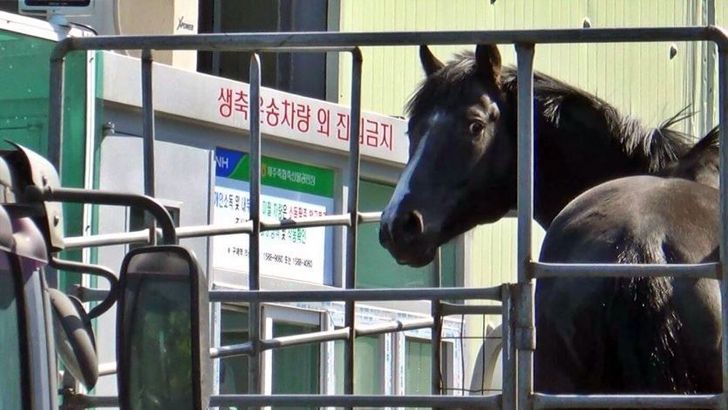
A retired racehorse “General Thunder,” who was put slaughtered at the age of four after retirement, arrives at a slaughterhouse in Jeju in 2018. Courtesy of Jeju Vegan
The panel experts called for introducing legislation and a transparent management system for horses and banning the use of racehorses as horsemeat. 99 percent of animals slaughtered for horsemeat are bred at studs as it is more lucrative than livestock farming, according to the 2019 report by Jeju Province's audit committee.
“There is no statutory provision for the welfare of horses, unlike for pets, farm animals, and exhibited animals,” said Park Chang-gil, the head of a domestic animal advocacy group Voice for Animals, pressing the need for legal grounds to protect horses.
“The racehorses are bred and trained to race as part of the 8 trillion won equestrian industry. It is clearly unethical to slaughter them for pet food or horsemeat when they are considered no longer financially viable,” said Park.