Pyongyang's armed drones pose new threat to Seoul

North Korean leader Kim Jong-un is seen in this undated photo released by the North Korean Central News Agency. Aug. 14. EPA-Yonhap
South Korea to launch UAV operation command Sept. 1 as North gears up to upgrade military drones
By Kang Hyun-kyung
Ukraine silenced naysayers who believed that the country would be no match for Russian armed forces and allow Russia to seize Kyiv and major facilities, paving the way for a Moscow-backed regime to assume control within days, if not months.
Refuting such predictions, under-equipped Ukraine has proven to be a formidable opponent as it uses creative commercial technologies to succeed in repelling Russia's modernized and well-financed armed forces.
In the media, Unmanned Aerial Vehicles (UAVs), or drones, are viewed as a magic bullet or a game changer enabling the underdog, Ukraine, to perform far better than expected on the battlefield against Russia's formidable military forces.
In South Korea, the use of drones to strike enemies in the Ukraine war has ignited a security debate.
Some experts voice worries that North Korea could be learning lessons from the Ukraine war and reach the conclusion that attack drones could be a cheap method of destroying its enemies. To thwart the fresh security threat posed by North Korean UAVs, the experts are calling on the South Korean government to introduce an effective anti-drone strategy and integrate it into comprehensive warfare plans.
Retired Navy Captain Yoon Suk-joon raised this possibility in an opinion piece published on 38 North in January.
“Certainly, North Korea is watching the war in Ukraine and learning at least some of these lessons…,” he wrote.
Citing a media report about North Korea's acquisition of a new type of UAV, Yoon claimed that the Ukraine war could have taught the North to take a fresh look at the utility of armed drones.
“This kind of median-altitude, long-endurance UAV is likely capable of operating for 40 hours and could be used for attack purposes rather than ISR (intelligence, surveillance and reconnaissance),” he wrote.
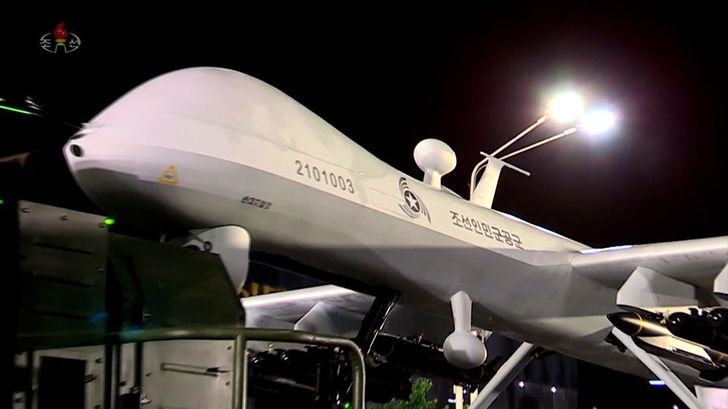
North Korea unveils an unmanned drone during a military parade, July 28. Yonhap
North Korea has developed indigenous armed UAVs.
The totalitarian state is believed to possess 500 to 1,000 UAVs capable of different roles. Among them are the Banghyun drones designed to strike enemy targets.
“They have plenty of them,” Kim Min-seok, a former spokesperson for the Ministry of National Defense and vice president of Korea Aerospace Industries Association in Seoul, told The Korea Times.
He said the North Korean strike drones are a relatively manageable threat, as long as they are used to strike South Korean military facilities.
“Media reports said Ukraine successfully intercepted and destroyed over 90 percent of drones equipped with weapons Russia has sent,” he said.
“Likewise, South Korea is prepared for this kind of attack. In the event of war, North Korea will want to target and destroy military installations, but the military equipment designed to intercept the drones are installed in South Korea's military installations.”
But he cautioned that a problem occurs when and if the North uses the UAVs to strike non-military facilities, such as industrial infrastructure or nuclear power plants.
“These sites are not equipped with the weapons systems that can intercept and destroy drones. Hence, the problem,” he said.
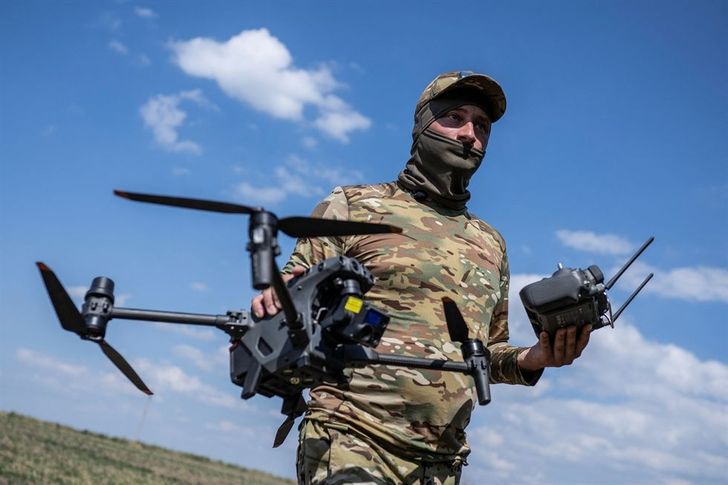
A Ukrainian soldier carries a drone and a remote controller during training, amid Russia's attack on Ukraine in Zaporizhzhia region, Ukraine, Thursday. Reuters-Yonhap
UAVs have been used for various purposes since reconnaissance drones were first deployed on a large scale in the Vietnam War.
They are deployed to collect intelligence and conduct surveillance, reconnaissance, electronic warfare and even information warfare.
The war in Ukraine shows that low-cost drones could be used to destroy expensive enemy weapons systems and industrial and other major infrastructure facilities, which is a shift from their previous use to strike terrorist targets.
Siemon Wezeman, a senior researcher at Stockholm International Peace Research Institute, observed that the prowess of UAVs in the war in Ukraine is exaggerated.
“It should be noted that drones have not revolutionized warfare,” he said in an email interview with The Korea Times. “They play a growing role, but are also sometimes a bit hyped. Weapons like tanks, guided bombs and other munitions play their roles and technology also empowered them to be more effective. Sensors of all types and the command and communications systems to which they are linked are more revolutionizing the drones.”
Kim presented a similar view about the role of drones in the war.
“Drones definitely are not a decisive factor determining the results on the battlefield in Ukraine,” he said. “But it's unfair to say drones are not playing any significant role in the war. Drones certainly helped the armed forces of the two countries implement their tactics on the battlefield.”
Kim Jong-hoe, a research fellow at the Korea Institute for Defense Analyses in Seoul, said North Korea so far has used the UAVs mostly for reconnaissance purposes.
“They didn't have sophisticated military equipment for reconnaissance, so they used drones for this purpose,” he said.
Kim, however, noted that the threat posed by North Korea's UAVs will reach a dangerous level when the North tries to deploy drones armed with bombs or other weapons.
“We've found pieces of evidence showing that North Korea has been deeply interested in UAVs as a cost-effective weapons system and tried to upgrade their capabilities to make them a more potent weapon. North Korea's efforts to upgrade UAVs is believed to have begun around 2014, as seen from the fact that related technologies, such as sensors and video cameras, have displayed a dramatic leap forward since that time period,” he said.
“North Korea is believed to have biological and chemical weapons. In case they use armed UAVs with biological or chemical agents, the consequences will be devastating.”
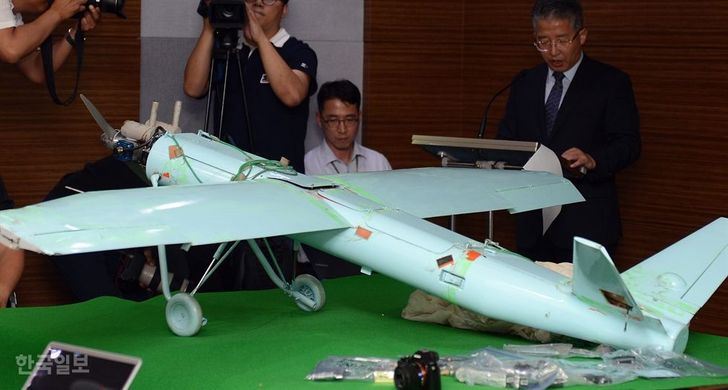
A Ministry of National Defense official gives a briefing on North Korea's unmanned aerial vehicle which crashed in Inje, Gangwon Province of South Korea, in this June 21, 2017 photo. Korea Times file
South Korea addressed the potential danger of North Korean drones in its military playbook.
The military has identified North Korea's UAVs as one of four asymmetric threats that must be tackled. The three others are nuclear bombs, missiles and cyberattacks.
The 2023-2027 Defense Mid-term Plan, released on De. 28, 2022, also addressed that a budget will be set aside to develop and acquire counter-UAV measures against North Korea's drone attacks.
Sensing that North Korean UAVs pose a growing threat to security, South Korea is preparing to launch the UAV Operation Command on Sept. 1.
The drone unit will be established under the auspices of the defense minister and a general-level official will oversee day-to-day operations. Other details of the command remain unknown.
President Yoon Suk Yeol said the UAV Operation Command will be established with “immense responsibilities,” stressing the need for strong anti-drone capabilities to thwart North Korea's aerial provocations.
“In the event of North Korean UAVs intruding into South Korea's airspace, the command will initiate operations against the adversary,” he said while presiding over a meeting of the defense reform committee on Aug. 8. “The command must show its resolve against North Korean provocations through its aggressive operations.”
The launch of the UAV unit comes nearly eight months after North Korean drones flew into South Korea's airspace.
On Dec. 26 last year, four UAVs of unknown type conducted flights around the western island of Ganghwa near the inter-Korean border and another UAV flew into the no-fly zone around the presidential office in Yongsan, Seoul. The South Korean military failed to intercept them and all five UAVs are believed to have returned to the North.
The president chastised top South Korean military brass for the failure.
“It was an incident showing unequivocally our military's poor readiness for North Korean aerial provocations and a lack of proper training,” he said while presiding over a Cabinet meeting held a day later. “The Korean public would have realized the danger of (the previous Moon Jae-in government's) North Korea policy, which relied on the North's goodwill and inter-Korean military accords.”