Top US military commander's remarks on war on Korean Peninsula inappropriate: experts

Gen. Mark Milley, chairman of the Joint Chiefs of Staff, arrives for a press briefing after participating in a meeting of the Ukraine Defense Contact Group at the Pentagon in Arlington, Va., July 18. AFP-Yonhap
By Lee Hyo-jin
Chairman of the U.S. Joint Chiefs of Staff (JCS) Gen. Mark Milley's recent remarks that the Korean Peninsula could be “in a state of war within a few days” were inappropriate, diplomatic observers said, Monday.
Local experts, who viewed that Milley's intention was probably to highlight Washington's commitment to maintaining peace and security on the peninsula, said that he should have been more prudent in his choice of words.
Park Won-gon, a professor of North Korean studies at Ewha Womans University, called Milley's remarks “inappropriate.”
“Such remarks, coming from the chairman of the U.S. JCS, not only create concerns among the South Korean public but also give an impression that the U.S. is being swayed by North Korea's strategy of creating tensions on the Korean Peninsula through continuous military provocations,” he said. “They certainly do not help in easing the tensions.”
The criticism came after the top U.S. military commander spoke about the security situation on the peninsula during an interview with Japanese daily Nikkei published on Saturday.
“I think that the Korean situation is an area that the United States could ― I'm not saying it will, but 'could' ― find itself in a state of war, you know, within a few days, with very little notice," the general was quoted as saying.
Milley described North Korean leader Kim Jong-un as “unpredictable.”
He also commented that the intercontinental ballistic missile (ICBM) fired by the North Korean regime on July 12 was “a very significant test of an ICBM that could range and hit the U.S. mainland.”
It is understandable for the American top general to perceive the current situation on the peninsula as a grave security threat to the Indo-Pacific region, but he may have gone too far, said Park.
“Milley's comments were symbolic, rather than accurate,” said Cho Han-bum, a senior researcher at the state-run Korea Institute of National Unification.
“If he was referring to a full-scale war, there's a slim chance for such a situation to occur with little notice. The current rising tensions may result in skirmishes, but a full-scale war is unlikely to happen abruptly without any warning signs.”
He added, “I think he wanted to highlight the U.S.' commitment to peace and security on the Korean Peninsula, and send a message that Seoul, Washington and Tokyo should team up against Pyongyang's nuclear threats.”
Cho said Milley's remarks could have been made within the context of rising nuclear tensions on the peninsula in recent months.
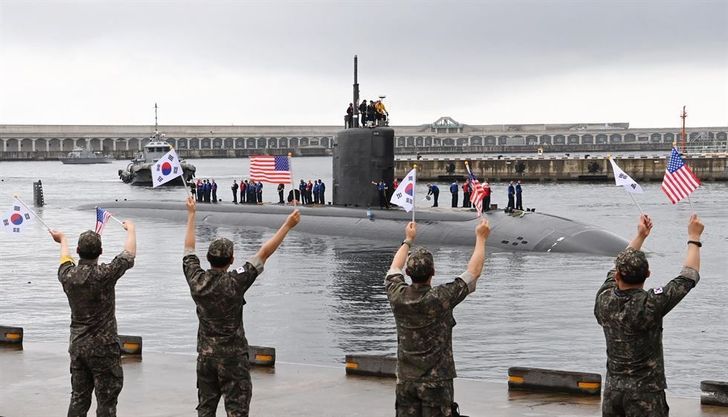
South Korean navy sailors welcome the entry of USS Annapolis, a Los Angeles-class fast attack nuclear-powered submarine, to a naval base on Jeju Island, Monday. Courtesy of Navy
On Monday morning, the USS Annapolis, a Los Angeles-class fast attack nuclear-powered submarine, entered a naval base on Jeju Island, just two days after North Korea test-fired cruise missiles.
“The goal of its entry into the port is to replenish military supplies during an operations mission,” the Republic of Korea Navy said, adding that the navies of both countries plan to strengthen their combined defense posture and conduct exchange activities.
On Saturday, Pyongyang fired several cruise missiles towards the West Sea, in an apparent protest against the deployment of a major U.S. strategic asset on the peninsula. Saturday's missile launch came a day after the USS Kentucky, an 18,750-ton Ohio-class nuclear ballistic missile submarine, departed from South Korea's Busan naval base.