Korea expected to face reduced military capability: lawmaker

Seen above is the prototype of the KF-21 Boramae fighter jet displayed at Korea Aerospace Industries (KAI) in Sacheon, South Gyeongsang Province. April 9. Yonhap
By Nam Hyun-woo
A serious shortfall in Korea's military capability is expected in the near future, as the country's plan to secure new assets to replace aging military aircraft and warships remains insufficient, a lawmaker said, Wednesday.
According to Rep. Ahn Gyu-back of the ruling Democratic Party of Korea, a significant portion of core assets owned by the Army, the Navy and the Air Force will be decommissioned in the near future. However, the pace of fielding new assets is slow and the number of aircraft and warships will be smaller than now even after their deployment is completed.
Citing Air Force data, Ahn said the number of fighter jets in operation stands at around 410 this year, but this number will decline to 360 in 2024 as old combat planes will reach the end of their service life.
Ahn said this is far below 430, which is the number of mission-proper fighter jets suggested by the Korea Institute for Defense Analyses (KIDA).
The Air Force has been pursuing the KF-X project, which is aimed at domestic development of the KF-21 Boramae fighter jet. However, the jet will be deployed no sooner than 2028, casting concerns of a potential deficit in air defense capability. The military said it plans to deploy 40 KF-21 Boramae fighter jets by 2028 and increase the number to 120 by 2032.
Ahn said the Army faces a similar situation, as nearly 80 percent of 280 attack helicopters in operation now have exceeded their service lives, with some of them operating more than 10 years longer than their lifespans.
“Given that the Army is planning to complete the deployment of new light armed helicopters and attack helicopters by early 2030, it is impossible to retire the current helicopters,” Ahn said.
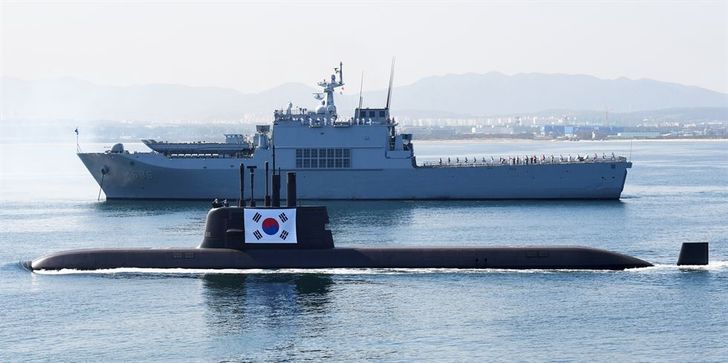
The Dosan Ahn Chang-ho submarine is seen in waters off Pohang, North Gyeongsang Province, during a ceremony to mark the 73rd Armed Forces Day, Oct. 1. Korea Times photo by Wang Tae-seog
In the Navy, Ahn expected the number of medium-size and large warships will decline by 30 percent and that of high-speed patrol ships will be halved, even though the Navy plans to introduce new vessels such as new frigates and Aegis-equipped destroyers. An official at Ahn's office added there has been no research done on the desired number of mission-appropriate vessels.
“Even though there are plans to introduce new assets, the military for years to come will face a serious vacuum in its capability, and this could have been prevented given the operational lifespan of those old assets,” Ahn said.
Ahn proposed a taskforce comprised of the Army, the Navy, the Air Force, the Joint Chiefs of Staff and the Defense Acquisition Program Administration to come up with countermeasures for buoying military capability.