US speeds up return of Yongsan Garrison site

Map of Yongsan Garrison in central Seoul
1/4 of Yongsan base to be returned by early 2022
By Nam Hyun-woo
The U.S. has agreed to return a 500,000-square-meter tract of land in the U.S. Army Garrison Yongsan, or about a quater of the site's total area, to Korea by early 2022.
According to the Ministry of Foreign Affairs, Thursday, the two countries' representatives held a Status of Forces Agreement (SOFA) Joint Committee Representative conference call and adopted a joint statement including more advanced plans for returning the military base in central Seoul.
The representatives were the ministry's North American Affairs Bureau Director-General Ko Yun-ju and U.S. Forces Korea (USFK) Deputy Commander Lieutenant General Scott Pleus.
In the statement, the representatives agreed to proceed with the return of “a considerable portion of Yongsan Garrison” and “identify the sections of Yongsan no longer in use that can be returned when all required transfer and force protection actions are complete.”
As part of this agreement, both sides have “committed to closely work together for returning nearly 500,000 square meters of Yongsan Garrison by early 2022.” This tract of land accounts for nearly a quarter of the base's 2.03-square-kilometer site that is subject to be returned.
Since 2002, Korea and the U.S. have been working on the return of 80 USFK facilities here to the Korean government, as part of a plan to consolidate the bases into one existing garrison at Pyeongtaek, Gyeonggi Province, and another in Daegu.
Of the 80 bases, the U.S. has returned 68, while the two sides are still narrowing their differences over the terms for returning the remaining 12, such as cleaning up any environmental contamination at the sites. The Yongsan base is one of these still under negotiation, even though the 8th Army and the USFK headquarters located there both moved to Pyeongtaek in July 2017 and June 2018.
In December of last year, the USFK for the first time returned 53,000 square meters of land inside Yongsan Garrison ― a sports field at the South Post and a softball field adjacent to the National Museum of Korea.
But at the same time, questions have risen over the slow progress of the return, given that the previously returned area accounted for only 2.6 percent of the total land.
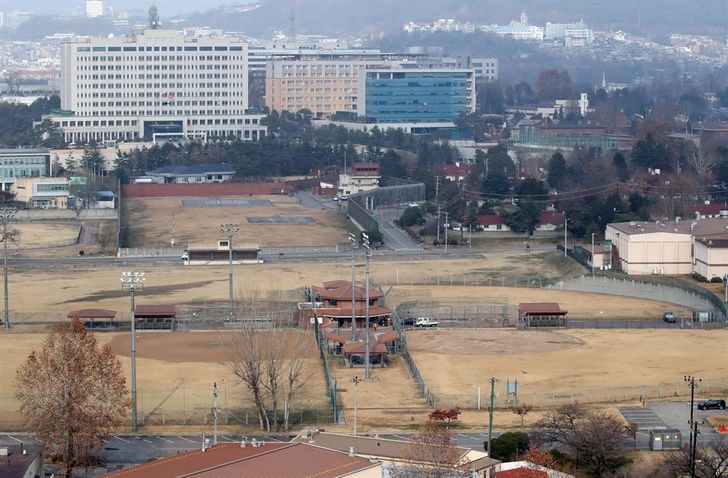
Yongsan Garrison in central Seoul / Yonhap
Though the two sides made progress by agreeing on returning a quarter of the Yongsan base's land this time, there are still several obstacles to overcome before the full return of the base, which the latest agreement failed to address.
One of them is the transfer of the ROK/U.S. Combined Forces Command (CFC) headquarters, which is still located in Yongsan Garrison. The USFK has yet to determine a timeframe for the transfer of the CFC headquarters, though the defense ministers of Korea and the U.S. in June 2019 agreed on moving the headquarters to Camp Humphreys in Pyeongtaek.
Without the headquarters' transfer, delays seem to be inevitable on the Korean government's plan to set up a national park on the Yongsan Garrison site by 2027.
The cost for decontamination of the area are another obstacle.
The Korean government plans to pay to decontaminate the site out of its own pocket first and bill the U.S. for the environmental cleanup costs later. But concerns have been lingering whether the U.S. will indeed bear the final responsibility for the cleanup cost, which is estimated to reach 1 trillion won ($872 million), because Washington has not paid decontamination costs in other countries in which its troops have been stationed.
“The two representatives agreed to encourage the Facilities and Areas Subcommittee and Environmental Subcommittee to continue cooperation and discussions, and conduct joint reviews as needed to ensure the successful return and grant of facilities and areas during calendar years 2021 and 2022,” the statement read without mentioning how the costs would be shared.
An official from Korea's foreign affairs ministry said, “The two sides will consult regarding cost-sharing in the environmental committee in accordance with SOFA processes.”