Korea advised to slow down pace for OPCON return

Soldiers of the U.S. Eighth Army, which is stationed at the U.S. Forces Korea (USKF) Camp Humphreys base in Pyeongtaek, Gyeonggi Province, exit a helicopter during a combat training demonstration in this June 2019 photo. / Yonhap
By Kang Seung-woo
Despite the government's push to regain wartime operational control (OPCON) of South Korean troops from the United States by a self-imposed deadline of 2022, defense analysts believe that the time is not yet ripe for Seoul to achieve its “ambitious” goal that has been shelved on multiple occasions, advising it not to rush to meet a political timetable.
South Korea was scheduled to take wartime control by the end of 2015, but the allies agreed to seek a "conditions-based" transition in 2014 due to an intensifying North Korean threat, without setting a new deadline.
However, since President Moon Jae-in took office in 2017, his administration has raced against time to return the wartime OPCON within his five-year presidency, or by 2022, and his ambition is well highlighted by newly appointed military leaders, including Defense Minister Suh Wook, all of whom have promised a quick OPCON return in concert.
“The transfer of wartime OPCON is a good goal that can be done successfully, and represents another stage in the evolution of the ROK-U.S. alliance into more of a partnership. But it should be done carefully and not rushed to meet a political timetable,” Naval War College professor Terence Roehrig told The Korea Times. ROK is an acronym for the Republic of Korea, South Korea's official name.
Leif-Eric Easley, an associate professor of international studies at Ewha Womans University, also told The Korea Times that the government's OPCON drive is based on its own political reasons, not the actual security situation.
“Because of the pandemic's disruption to training schedules, evolving threats posed by North Korea, and the need to update roles and institutions within the alliance, wartime OPCON transfer during the current administration may be overly ambitious,” he said.
“Such a decision is ultimately political, but should be based on specified conditions and meeting functional criteria as much as possible.”
Those conditions include the acquisition of necessary military capabilities for a South Korea-led combined defense, the securing of critical military response capabilities by the South to deal with North Korea's nuclear and missile threats, and the security environment on the Korean Peninsula and in the region.
Here, the OPCON transition is seen as the nation's restoration of military sovereignty, but Daniel Sneider, an international policy expert at Stanford University, said the South Korean military still depends on its U.S. counterpart in many areas.
“Most American defense analysts believe that none of these preconditions have been achieved. Reduction of tensions is not the same thing as denuclearization,” he told The Korea Times.
“And while Koreans have made progress on some of the defense reforms and acquisitions, they are still heavily reliant on the U.S. forces particularly when it comes to command and control, communications, intelligence, and surveillance systems that are essential to operating combined forces in wartime. Koreans have made slow progress themselves on building the ability for their own forces to conduct joint and combined operations.”
As part of an assessment of the South Korean military's OPCON readiness, the allies have been utilizing a three-phase verification process of initial operational capability (IOC), full operational capability (FOC) and full mission capability (FMC).
Last year, the two sides conducted an IOC test, but they failed this year to fully assess the FOC, in which a South Korean commander takes responsibility for the combined defense posture, as they had to scale back the summertime exercise due to the COVID-19 pandemic, raising speculation that the OPCON transition may again be delayed.
“It is also important to point out that there needs to be testing of whether this can be done with an ROK general in charge. For that, there needs to be large-scale joint exercises of the kind the two militaries used to carry out regularly,” Sneider said.
“But no such exercises have taken place for the past two years ― something the Moon administration has strongly encouraged in pursuit of its engagement strategy toward North Korea. So if the Moon administration really wants this OPCON transfer to take place, they need to change their view on holding large scale joint field exercises.”
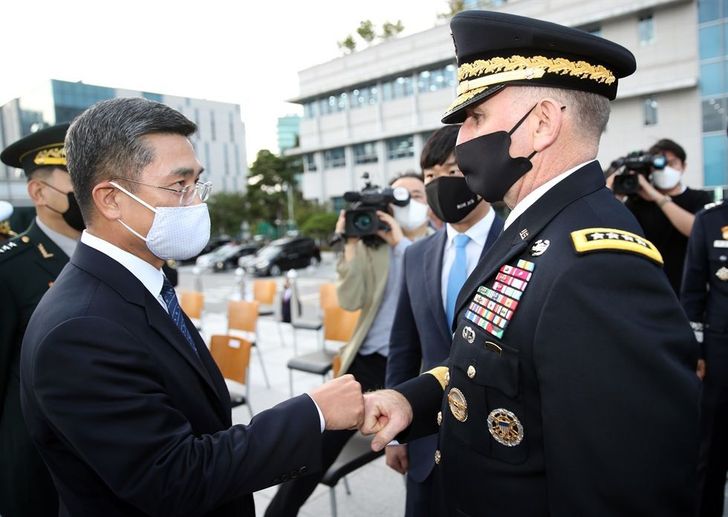
Defense Minister Suh Wook, left, bumps fists with U.S. Forces Korea Commander Gen. Robert Abrams at the inauguration ceremony of new Joint Chiefs of Staff (JCS) Chairman Won In-choul at the JCS headquarters in Seoul, Wednesday. Suh seeks to expedite Opcon transfer on the basis of a firm alliance with the United States. / Yonhap
What's more, Gen. Robert Abrams, the commander of the U.S. Forces Korea, told a virtual forum earlier this month that the three steps are not the only requirements the allies have to meet, and there are more to assess ahead of the OPCON transfer.
“There is a gross lack of understanding in the public space about what it is,” he said during a webinar hosted by Center for Strategic and International Studies (CSIS).
“They are conflating that IOC equals condition one, FOC equates to condition two and FMC equals condition three. These are apples and oranges.”
OPCON advocates fear that unless the transition is made within the Moon presidency, the drive may lose momentum after his term in office ends. However, Roehrig said it would not be easy to ditch the plan, citing its progress thus far.
“No doubt, the Moon administration fears that if this is not accomplished during its time in office, the process will be scrapped, particularly if a conservative administration follows in 2022,” he said.
“But after years of working for this goal, there is a good deal of momentum behind this move that may be difficult for opponents to stop.”
After the OPCON transition, a South Korean general will lead the future Combined Forces Command (CFC), with a U.S. general as a deputy.
In that respect, speculation is arising that the U.S. is trying to strengthen the functions of the United Nations Command (UNC), led by the U.S. Forces Korea commander, in order to maintain its presence on the Korean Peninsula.
“The idea that the U.S. wants to maintain control of the CFC by using the UNC seems to be a conspiracy theory promoted in certain South Korean progressive circles. In reality, in a Korean-led CFC, the commander is still subordinate to the national command authorities of both countries,” Sneider said.
Roehrig also said, “The U.S. has been trying to increase the role and effectiveness of the UNC and its member countries, but the U.S. does not see the UNC as a possible competing command structure.”