97-year-old Filipino war vet vividly remembers harsh days in Korea
Retired Major General Max Young shares his memories of Korean War
By Jung Da-min
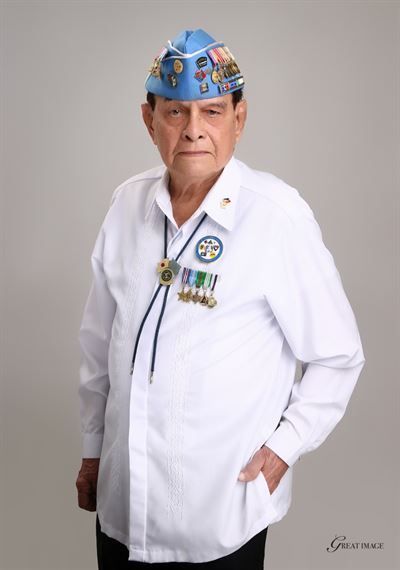
Max Young, a 97-year-old retired major general of the Philippine Army and veteran of three wars ― World War II (1939-45), Korean War (1950-53) and Vietnam War (1955-75). Courtesy of Max Young
Max Young, a 97-year-old retired major general of the Philippine Army and veteran of three wars ― World War II (1939-45), Korean War (1950-53) and Vietnam War (1955-75) ― says he considers his service in the Korean War a highlight of his military career.
Born in 1922, his military career began at age 19 during World War II. He participated in the Korean War as a first sergeant and tank platoon commander of the 10th Battalion Combat Team (BCT) of the Philippine Expeditionary Force to Korea (PEFTOK). The 10th BCT was the only Philippine Army tank battalion at the time.
“We set sail from Manila on Sept. 15, 1950, landed in Busan on Sept. 19 that year and stayed in Korea until Sept. 27 the next year,” Young told The Korea Times in a recent email interview. “The 10th BCT was the first and most bloodied BCT among five BCTs sent by the Philippines to Korea as it suffered the most deaths, injuries and missing in action.”
Young recalled two major battles. In the first one on Nov. 11, 1950, he and his comrades were ambushed by North Korean soldiers in an area around Singye, North Hwanghae Province. Surviving the ambush, Young exited his tank and fired a turret machine gun on enemy positions which led to the first victory by Philippine troops on foreign soil. His contribution was belatedly recognized by the Philippine government which awarded him a Gold Cross Medal, the country's fourth-highest military award given for gallantry in action.
The other incident was the Battle of Yuldong, known as the greatest Philippine victory in the Korean War, which took place on April 22 and 23, 1951, in Yeoncheon, a county in Gyeonggi Province bordering present-day North Korea. About 900 Filipinos of the 10th BCT defending a three-mile segment of Line Utah, the northernmost United Nations Command defensive line inside North Korea, fought against an overwhelming force of 40,000 soldiers of the Chinese People's Volunteer Army. Thanks to the successful defense by the 10th BCT, the U.S. military retreated safely.
The South Korean government later built the Korean War Memorial Pylon in the Philippines' Libingan ng Mga Bayani (Resting Place of Heroes) to honor the fallen service members, especially to commemorate the PEFTOK victory in the Battle of Yuldong. In 2016, Young received the Taegeuk Order of Military Merit, the highest military decoration for valor in Korea, from then-Prime Minister Hwang Kyo-ahn on behalf of then-President Park Geun-hye.
Looking back on his days in Korea seven decades ago, Young recalled that Korea was experiencing one of its coldest winters when he arrived in Busan.
“Coming from a warm country as the Philippines, it was the first time we were exposed to the harsh cold weather,” Young said. “We pitched our tents in an open field and many of us including me woke up with rice snakes in our tents. The snakes apparently fled the cold and sought warmth beside our warm bodies.”
Young also recalled the first time he encountered Koreans when he arrived in Busan: “It was also in Busan that we first came face-to-face with frightened and thin Korean refugees, many of them children, begging us for food. We shared whatever we could.”
He said he still vividly remembers the scene of a seemingly unending stream of Korean refugees fleeing combat zones during his first month in Korea and there seemed to be children who lost their parents among those refugees. “It was heartbreaking,” he said.
Young said he was amazed at what Korea has achieved after the war and he still sometimes finds it difficult to relate the country where he fought in the 1950s to what Korea is now. He has visited Korea multiple times as part of the Ministry of Patriots and Veterans Affairs' Korea revisit program or as part of the Philippine military contingent for special events organized by governments or other civil organizations.
He also thanked the Korean government for sending face masks to him and his fellow veterans in the Philippines during the COVID-19 pandemic.
“All my fellow living veterans ― there are only 170 of us living now out of the 7,400 who served ― and their families as well as thousands of living descendants of deceased veterans got the K-95 masks. This is a big help to us Filipinos in times of this pandemic,” Young said. “This act of sending us precious masks just shows Korea cares and shares not only in better times, but in hard times. This is one of the greatest acts the Korean government has done.
On behalf of his family, fellow veterans and their descendants, he added “Maraming salamat,” an expression of gratitude in his language.