US on track to reduce troops in S. Korea
.jpg?w=728)
United Nations soldiers participating in the 1950-53 Korean War pose for this file photo. / Korea Times file
By Lee Min-hyung
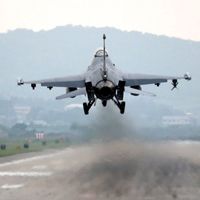
A U.S. Air Force F-16 fighter jet takes off from Osan Air Base in Pyeongtaek, Gyeonggi Province, during the joint Max Thunder air exercise with South Korea, May 16. / Yonhap
There is a growing possibility for the United States to downsize its troops in South Korea, with U.S. President Donald Trump expressing his firm determination toward the move amid a peace overture initiated by North Korean leader Kim Jong-un's pledge for denuclearization.
The U.S. Forces Korea (USFK) has served as a major war deterrent since the 1950-53 Korean War. With Seoul and Pyongyang having since failed to sign a peace treaty, both sides remain in a technical state of war.
After deploying the USFK, the U.S. has for decades reduced the number of the troops here for political and economic reasons. Washington has maintained 28,500 USFK troops in South Korea since April 2008 when then-South Korean President Lee Myung-bak and then-U.S. President George Bush agreed to maintain the troop size.
But the U.S. is on track to bring up again the possibility of a USFK reduction, driven by the ongoing peace momentum on the Korean Peninsula.
Last week, Trump and Kim held a first-ever Washington-Pyongyang summit in Singapore where the two unpredictable leaders reached agreements to realize complete denuclearization of the peninsula.
If the North continues to make efforts to keep its promise and the two Koreas declare an end to the current state of war, this removes several justifiable reasons for the USFK to be stationed here.
“It depends on how sincerely North Korea carries out proper steps for denuclearization,” said Kim Sang-ki, director at the Korea Institute for National Unification's policy division. “It is likely for Washington to cut down on the size of the USFK only when it believes Pyongyang does not pose a significant military threat.”
U.S. Secretary of State Mike Pompeo said recently the U.S. is seeking to finish the regime's denuclearization processes by the end of Trump's current term in 2020.
“Once the North makes concrete and appropriate steps for denuclearization with the U.S., and removes most of its major nuclear and missiles facilities, chances are the USFK reduction can come into reality within a couple of years,” he said.
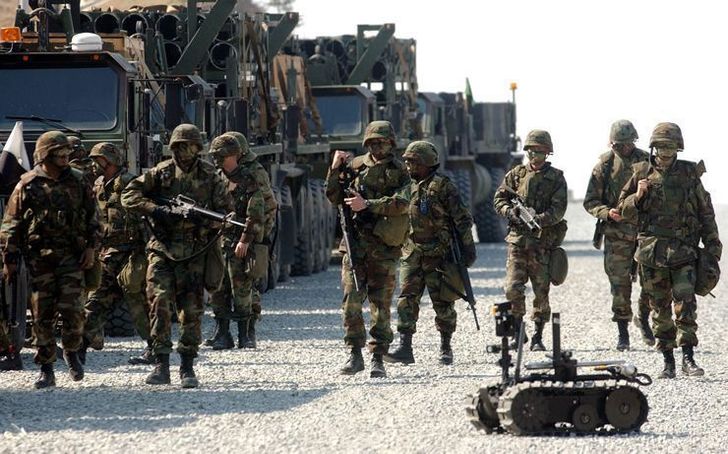
U.S. Army soldiers walk with a military robot during a joint exercise in Daegu March 20, 2005, as part of annual Seoul-Washington joint drills. / AP-Yonhap
USFK history
It was in September 1945 when the U.S. deployed its troops for the first time on the peninsula. The dispatched troops served their duties to disband remaining Japanese armed forces after the latter surrendered to the Allied Forces on Aug. 15, 1945.
The U.S. then withdrew its troops and deployed again in the wake of the outbreak of the Korean War. In August 1953, Seoul and Washington signed a mutual defense treaty to legalize the USFK to be stationed in South Korea.
The size of the USFK back in the 1960s stood at 63,000. But with U.S. President Richard Nixon taking office in 1969, Washington pursued a policy of detente under which Nixon pushed for withdrawing U.S. troops in Asia and urged Asian countries to be more responsible for their own defense.
Under his policy drive, Washington withdrew 20,000 USFK troops in March 1971. In 1977, U.S. President Jimmy Carter also declared the withdrawal of the USFK, drawing strong protest from the South Korean government. Despite such fierce opposition, about 3,400 U.S. soldiers made their way back to their homeland.
.jpg?w=728)
A U.S. Air Force F-16 fighter jet takes off from Osan Air Base in Pyeongtaek, Gyeonggi Province, during the joint Max Thunder air exercise with South Korea, May 16. / Yonhap
Controversy surrounding the USFK withdrawal also erupted again in the early 1990s under former U.S. President George H.W. Bush. By the end of 1992, Washington redeployed 7,000 USFK troops ― 5,000 from the Army and 2,000 from the Air Force.
The U.S. planned to cut down an additional 6,500 soldiers by 1995, but it failed to come into reality amid concerns over the North's nuclear development.
With Pyongyang stepping up its nuclear threats against Seoul and Washington, the U.S. has since not pushed ahead with any drastic reduction in the number of its troops here.
Trump said recently he does not have plans to downscale the USFK at the moment.
But given his outward discontent with the present cost-sharing deal to maintain the USFK here, Washington may choose to cut down the troops in the near future when the North possibly scraps “threatening” nuclear weapons and missiles to be in line with its ongoing peace agreements with the South and the U.S., according to the unification expert.
“This is because the existence of the USFK here is to defend South Korea against potential threats from the North,” he said. “If the regime gives up its military threats in a verifiable way, the role and the size of the USFK will definitely change.”
In April, leaders of the two Koreas also held a summit on the inter-Korean border village of Panmunjeom where South Korean President Moon Jae-in and Kim Jong-un signed a landmark declaration under which both sides agreed to formally end the Korean War no later than this year.
This was the first time Kim, who took office in 2011, offered to hold a summit with his South Korean counterparts.
As of now, no specific progress has been made to realize their joint agreement over putting an end to the current state of war.
But Seoul and Washington are also expressing their willingness to bring peace to the peninsula by suspending joint military exercises.
Once Seoul and Pyongyang declare an end to the war, and the North continues to take the right steps toward complete, verifiable and irreversible denuclearization, Trump will likely implement other detailed measures to speed up his eventual goal of withdrawal of the USFK, according to the expert.