Radar, missiles, patrol aircraft possibly on arms shopping list
By Jun Ji-hye
All eyes are on which U.S. military assets are on Seoul’s shopping list, following the agreement between President Moon Jae-in and U.S. President Donald Trump to begin consultations on South Korea’s acquisition and development of advanced U.S. weapons.
At a joint news conference after their summit in Seoul Tuesday, Moon said talks will begin between the allies on Seoul’s acquisition and development of state-of-the-art military surveillance assets to improve the nation’s defense capabilities against growing North Korean threats. Trump also said South Korea will be ordering “billions of dollars of that equipment.”
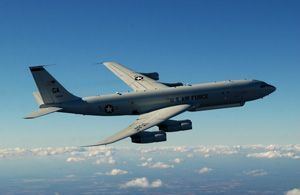
E-8C JSTARS

P-8A Poseidon
An item that is being mentioned the most is the E-8C joint surveillance and target attack radar system (JSTARS) aircraft that, if introduced, will be used to closely monitor the North’s ground and naval forces.
The JSTARS uses multi-mode, side-looking radar to detect, track and classify moving ground vehicles in all conditions deep behind enemy lines, according to the U.S. Air Force. The aircraft is the only airborne platform in operation that can maintain real-time surveillance over a corps-sized area of the battlefield, the Air Force said.
Other potential items on the list include ship-based Standard Missile-3 (SM-3) interceptors and P-8A maritime patrol aircraft.
SM-3s are designed to shoot down incoming missiles at altitudes of 150 to 500 kilometers, which is much higher than the Terminal High Altitude Area Defense (THAAD) system’s intercept altitude of 40 kilometers to 150 kilometers.
Seoul’s import of SM-3s has become a possibility after it was revealed that South Korea’s second batch of Aegis destroyers, which will be built by the mid-2020s, will have an advanced, integrated air and missile defense system that includes the capability of intercepting enemy missiles.
The P-8A Poseidon is designed for long-range anti-submarine warfare and anti-surface warfare, as well as intelligence, surveillance and reconnaissance missions, according to its manufacturer, Boeing. It is capable of broad-area maritime and littoral operations, the company said.
Some observers say Seoul could buy 20 more F-35 stealth fighters in addition to 40 jets that South Korea has already purchased.
The nation had originally planned to buy 60 F-35s for its Air Force but reduced the number to 40 due to budget issues.
Military sources here say the purchase of advanced U.S. weapons would be necessary to some extent to fulfill the Moon Jae-in government’s pursuit of regaining wartime operational control (OPCON) of South Korean forces from the United States at the earliest possible date.
Defense chiefs of the two nations agreed last month to make joint efforts to satisfy conditions for the prompt transfer of the wartime OPCON from Washington to Seoul.
A Cheong Wa Dae official refused to talk about details of weapons the nation would purchase, saying, “Decisions have yet to be made on exactly which weapons to acquire and how many of them to buy.”