INTERVIEW Seoul should push for THAAD deployment
By Kim Jae-kyoung
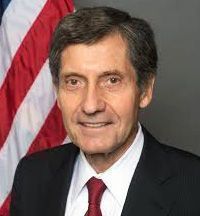
Joseph DeTrani
South Korea should push ahead with the deployment of a Terminal High Altitude Area Defense (THAAD) battery here in the face of China’s strong opposition, according to a former U.S. special envoy to the six-party talks with North Korea.
“Deploying THAAD is necessary, especially given North Korea’s numerous missile launches, all in violation of U.N. resolutions prohibiting such launches,” Joseph DeTrani said in an interview.
“Regardless of China’s opposition, THAAD and other missile defense capabilities are necessary, given North Korea’s reckless behavior.”
His advice came as China has stepped up its economic retaliation against Korean companies over President Moon Jae-in’s recent order to deploy four additional THAAD launchers.
The order came shortly after North Korea’s second test of an intercontinental ballistic missile (ICBM) capable of reaching the U.S. mainland.
DeTrani, who helped broker a 2005 agreement on North Korea’s nuclear program, said China should do more to rein in Pyongyang by employing its strong leverage.
He believes the most effective and viable option to resolve the North Korean nuclear issue is for China to arrange exploratory talks between North Korea and the U.S. or South Korea to facilitate a return to formal negotiations.
According to him, China, which provides over 90 percent of North Korea’s crude oil, can cut back on its crude oil supply to North Korea. Also, since over half of the North’s trade is with China, any reduction would adversely affect the North.
“These levers are available to China.The decision to use them is part of China’s calculus for dealing with North Korea,” he said.
“Currently, however, China’s greater contribution, in my view, is to get North Korea to halt its missile launches and nuclear tests and agree to unconditional exploratory talks with the U.S. and South Korea.”
He said the six-party construct, which produced the Sept. 19, 2005, Joint Statement, a comprehensive approach to denuclearization of the Korean Peninsula, is still viable.
He pointed out the six-party talks facilitated bilateral discussions with North Korea and South Korea, Japan and the U.S.
DeTrani, president of the Daniel Morgan Academy in Washington, said Moon should seek dialogue only when North Korea agrees to halt its missile launches and nuclear development.
“South Korea’s strategy of seeking dialogue, for complete, verifiable and irreversible denuclearization, while imposing sanctions when dialogue is not possible is a reasoned, fair approach,” he said.
In his view, Moon’s approach of leaving the door open for talks despite Pyongyang’s missile launches won’t weaken the effect of international sanctions, as long as sanctions continue to be imposed in response to the North’s missile launches and nuclear tests.
“I would definitely be opposed to a dialogue while the North was launching missiles and conducting nuclear tests,” he said.
“Dialogue conditioned on the North halting missile launches and nuclear tests seems reasonable to me.”
DeTrani, also former director of the U.S. National Counter Proliferation Center, dismissed the view that China’s policy is ambivalent.
“China has supported sanctions on North Korea and has consistently stated that complete, verifiable and irreversible dismantlement of North Korea’s nuclear programs is Beijing’s policy,” he said.
“That is the core issue, denuclearization of the Korean Peninsula, which Beijing has supported since the beginning of the six-party talks process in August 2003.”