'We must first reach out to contending political forces'
.jpg?w=728)
The late President Kim Dae-jung poses with former U.S. Ambassador to Korea Donald P. Gregg, right, in February 1998. On the left is Jon Stevens Corzine, former chairman and CEO of Goldman Sachs. / Korea Times file
How The Korea Times captured sense of irony
By Donald Gregg
At the very end of December 1971, I boarded a Korean Airlines jet at Saigon’s Tan Son Nhut airport for a flight to Hong Kong starting my return flight to Washington, D.C., for home leave. I had spent two Christmases in Bien Hoa, 20 miles from Saigon, and I was anxious to see my family.
On the aircraft was a copy of The Korea Times, vividly describing a devastating fire which had taken place on that recent Christmas night at the Daeyeongak Hotel in Seoul. Scores of people had been killed, and the article detailed the variety of mistakes that had been made, from shoddy hotel construction to locked fire doors, that had caused the tragedy’s horrific dimensions.
Accountability was the theme of the article, and its writing was brilliant and biting. Why do I remember it after more than 43 years? Because I had spent the previous 15 months in a place where saying “Sorry about that” was what passed for accountability in a losing American war effort in a disintegrating Vietnamese society.
I had visited Korea once, in 1968, and had been attracted to the vitality of Seoul, the beauty of the countryside, and the direct and friendly nature of the Koreans that I met when taking a train to Busan.
On the long flight home I thought a lot about my previous experiences in Asia, and Korea clearly emerged as a place to which I wanted to be assigned. It was a country in which our war effort had largely succeeded, where dynamic economic development was taking place, and where people were being held accountable for their actions.
So when my tour in Vietnam finally ended, in June 1972, for the only time in my career, I applied for a specific assignment, as chief of station for the CIA in Seoul. My family and I arrived there in July 1973, and that unforgettable Korea Times article had played its part in bringing us to Seoul.
I have been told that the first issue of The Korea Times was printed on November 1, 1950. I cannot imagine how it was possible to print a newspaper in Seoul at that time, the city having changed hands four times in the previous months of furious fighting. But printed it was, and what a story has been told since that day.
But since its very beginning, the Korean-American story has been a violent and tumultuous one, when the American ship General Sherman was sunk and burned in 1866 in the Taedong River in Pyongyang, trying to force the so-called Hermit Kingdom to open itself to foreign trade.
The Taft-Katsura agreement, furtively concluded by the U.S and Japan at the Treaty of Portsmouth in 1905 when the Russo-Japanese war was ended, opened the way for Japan’s annexation and occupation of Korea.
And in 1945, when Japan surrendered, the U.S., not having anticipated the Soviet Union’s intention to occupy all of Korea, hastily suggested that Korea be “temporarily” divided along the 38th parallel. The Soviets accepted this division, and the stage was set for the Korean War. No Koreans had been consulted in either of these two epic decisions.
Since The Korea Times went to print in 1950, there has been no let-up in the action, including vicious fighting until 1953 when the Armistice was signed, ending the Korean War. But still, no peace treaty has been signed. And a very complicated, and vitally important chapter lies ahead for the Times to report and interpret.
Koreans have a powerful sense of history, and a marked tendency to hold previous decision-makers, foreign and domestic, accountable for their actions. “Forgive and forget” is not the Korean way, and many of my oldest and dearest Korean friends are still traumatized by their memories of the Korea War and its horrors. They have never forgiven me for my close relationship with the late Korean President Kim Dae-jung, and are deeply suspicious of my continuing determination to talk with the North Koreans.
The recent brutal knife attack on Ambassador Mark Lippert brings many contending issues to the fore. I immediately sent Ambassador Lippert a message expressing my sympathy for what had happened to him, but congratulating him for his heroism and his humor in handling the attack. I assured him that the Koreans would be deeply embarrassed by having allowed the attack to take place, and that his gallantry would endear him to the Korean people.
In saying this, I recalled clearly how my wife’s “grace under pressure” when the embassy residence was attacked and broken into by six Korean students in October 1989, got our tour off to a great start.
But now what will happen is unclear. “Who is to blame?” is the rampant question. There is no easy answer to that question and it deserves quiet and prolonged investigation.
I believe that this tragic incident gives President Park Geun-hye a valuable chance to say to all Koreans, North and South, “This event is unworthy of us. No explanation can justify it. What can justify it, is our own recognition than we can no longer be haunted by the past, we must first reach out to contending political forces in the South, to find an agreement on how to achieve trust and eventual reconciliation with the North.” That is the essence of “trustpolitik,” a theme she has talked about but not yet implemented.
Now is her chance, and I hope that The Korea Times will urge that she lead such a movement. If she does, she will show that she possesses both her father’s courage, and her mother’s compassion.
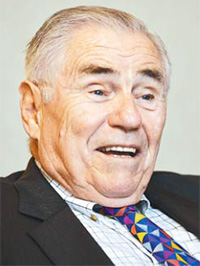
Donald P. Gregg was U.S. ambassador to Korea from 1989 to 1993 and is chairman of the Pacific Century Institute.