Reflections on my experiences in Korea

Former President Kim Young-sam offers a toast during a dinner meeting on Dec. 20, 1996. On the right is former U.S. Ambassador to Korea James T. Laney. Gen. John Tilleli, former commander of the South Korea-U.S. Combined Forces and U.S. Forces Korea, is seen second from left. / Korea Times file
Former US envoy recalls days leading to birth of The Korea Times
By James T. Laney
It was a bitterly cold January day in 1947 when I arrived for the first time in Korea at the port of Incheon, a 19-year-old recently inducted into the U.S. Army. Korea was yet to recover from the depredations of a long Japanese occupation.
It was a year-and-a-half before the first ROK elections and the 38th parallel was then only a political line between North and South, not a military barrier it would soon become.
While my first impression of Korea was hardly auspicious, it was soon eclipsed by the warmth and generous hospitality of its people, who quickly won my heart.
My assignment was as a special agent in the 971st Counter Intelligence, with headquarters in a former Japanese bank on Jongno Il-ga. There was no The Korea Times then ― indeed no English language newspaper ― so part of my duties was to write summaries of information about political affairs for the U.S. 24th Corps Headquarters.
Occasionally a colleague and I would drive up the hill to the home of Syngman Rhee where we would interview him on political events taking place. At the time there was much jockeying going on in anticipation of upcoming national elections and he, of course, was a prominent contender.
During that early period I investigated several assassinations of prominent political figures. Despite the machinations I became privy to, I became thoroughly attached to my Korean friends and colleagues, and to the country and culture. That initial experience would change the course of my life.
Upon returning to Yale in 1948, I completed my degree in economics. But Korea stayed in my heart, and I decided not to go to Wall Street upon graduation but rather to attend Yale Divinity School and enter the ministry.
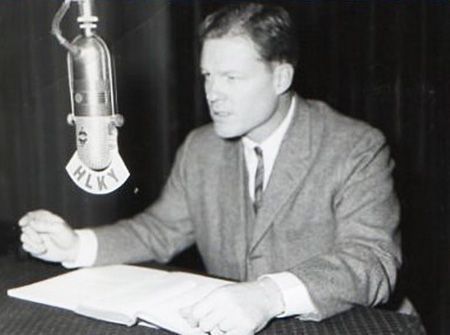
James T. Laney speaks during a radio program while working as a Methodist missionary in Seoul in 1962. / Courtesy of James T. Laney
So it was hardly a surprise to family and friends back home when I decided to return to Korea in 1959, married and with three children. (Two more were born in Korea). I was assigned to Yonsei University where I was to work for five years among students.
But in contrast to the 1940s when I first came, this time there was an English language paper, The Korea Times, and it kept us all abreast of major news and events. This was most welcome.
The first major event was the April 19, 1960, student revolution that toppled the Rhee presidency. The excesses of that administration had ignited the anger of the general populace and students across the country rallied publicly against it.
The news was carried daily in the Times, with pictures of soldiers shooting student demonstrators in downtown Seoul. The ensuing outrage brought international criticism and the U.S. withdrew its support for Rhee, who was exiled to Hawaii.
A new election brought Yun Posun into the presidency. But the students had tasted power and notoriety, and the country became awash in demonstrations and unrest as a result of their demands.
The Korea Times earned the respect of us all by highlighting in an objective fashion those excesses. The situation worsened and the public was alarmed but indecisive.
My wife and I were at dinner with embassy officials on a June evening in 1961 when suddenly a message came that called the DCM and several others away abruptly. We left that night without knowing what had happened.
The next morning the news was flashed: there had been a coup the previous evening and a military government had taken over. Initially there was great consternation. What did this portend? Who was Park Chung-hee, the leader of the coup?
It turned out that the embassy was worried about the possibility of a communist seizure. While it soon became apparent that such concerns were groundless, the new regime did move quickly to impose authoritarian order upon society.
Over the next several years the foundations for a modern economy were laid but it would be almost 20 years before the seeds of democracy could flourish. During that time The Korea Times proved an invaluable source of news and commentary.
My work at Yonsei and among students across the country was hugely satisfying. They were idealistic and intent on nation building and service. A group of medical, nursing and dental students formed the VV Club, modeled after the great medical missionary and Nobel laureate, Albert Schweitzer.
They set up a clinic on weekends in an impoverished village 30 miles from Seoul and carried that on for years through multiple generations of students.
After five years in Seoul and having made many beloved colleagues and friends, we returned to the U.S. and another stint at Yale before beginning an academic career in America. Eventually I became president of Emory University where I served for 16 years.
In 1993, Senator Sam Nunn and former President Jimmy Carter, aware of my experience in Korea, urged President Bill Clinton to appoint me as ambassador to the ROK. Korea had emerged as a full-fledged democracy and was on the way to being a major world economic force.
But it was the nuclear crisis that dominated my years at the embassy in Seoul. We averted war in 1994, but the process of negotiating with North Korea was contentious, both in Korea and in the U.S. Often rumors spread that had little foundation in fact, some intentionally designed to undermine our efforts.
On one occasion the misrepresentation was so egregious that I sought an interview with The Korea Times, and they carried an authoritative account to set the record straight. This was a case study in nurturing democracy, a never ending task, for accurate news and balanced editorials are essential to its flourishing.
I have always been grateful for the opportunity to serve both my country and my dear friends in Korea in seeking to safeguard and further that noble heritage. And I congratulate The Korea Times on its anniversary and the splendid job it has done through the years in fostering that tradition.
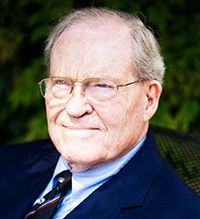
James T. Laney was ambassador to South Korea from 1993 to 1997, and was decorated by both the Korean and American governments for his services. He is president emeritus of Emory University where he served for 16 years.