'communication is key to multiculturalism'
By Kim Se-jeong
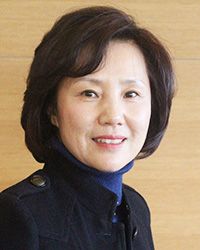
Shin Suk-ja
Shin Suk-ja, the new chairwoman of Association of Korea Multicultural Family Support Centers, is facing a tough task.
The government is planning to combine 217 family support centers with the Family Health Support Centers, another type of social welfare organizations, in an effort to reduce redundant services.
The 217 centers opposed the idea, claiming that the move will make interracial families more vulnerable through reduced services.
In an inauguration ceremony last week in Seoul, the new chairwoman said she’d communicate closely with the Ministry of Gender Equality and Family to narrow the difference.
“Our coordination is important in delivering quality services to interracial families. I will work to promote effective communications between the two organizations,” she said.
The Korea Multicultural Family Support Centers are the centerpiece of the government’s interracial family support policy. The first center opened in 2006.
“They are a very special minority group in the society that needs specialized support. The move will eventually hurt these families,” Shin said. The government expects to finish combining the centers by 2017.
Shin is serving as the director of the Multicultural Family Support Center on Ganghwa Island, Gyeonggi Province.
She was among the early members of the center, which was recognized by the ministry in 2007.
She said she was first drawn to this work in 2005 after encountering a female immigrant on the island.
The woman carried her baby on her back. Shin was studying social welfare for her master’s degree at the Catholic University of Korea back then and was a volunteer family counselor.
“I was on my way to visit one of my clients. She was standing outside her home, and her face shows no life. She was like a walking dead body. When I asked my colleague about her, he answered that she came to the island through a marriage,” Shin recalled. At the time, such immigrants were still rare on the island.
“My heart ached when I remembered her soulless face. I went back to see her about 10 times for the next month. I just held her hands and tried to talk to her about the baby. She had no reaction at first, but during one visit, she wept. She finally opened up her heart to me.” The mother was socially isolated and discriminated by the community.
That incident inspired her to do for interracial families on the island. She wrote about the immigrant women on the island in her school report.
“My job requires commitment and heart to carry on,” Shin said. “The success of my work doesn’t lie on the number of people we provide the service to .”
Her center offers workshops and counseling to women who become residents through marriage. It also used to offer Korean language classes, but that task is now performed by the municipal governments.
The 217 support center also want more autonomy in planning and implementing its projects, and she wants to achieve this through close coordination with the ministry.