Early warning systems augmented

A North Korean vehicle carries a missile during a mass military parade in Pyongyang’s Kim Il-sung Square to celebrate the centenary of the birth of the late North Korean founder Kim Il-sung in this April 15, 2012, file photo. / AP-Yonhap
By Kim Tae-gyu
South Korea and the United States have deployed all available military resources as a missile launch by North Korea to coincide with the anniversary of the birth of its late founder Kim Il-sung on April 15 looks imminent.
State-of-the-art ground, sea and air radar systems are being fully utilized, military officials said Wednesday. Reconnaissance satellites and unmanned aerial vehicles are also in operation and interceptor missiles have been readied.
The steps are part of the raising by the Combined Forces Command (CFC) of its military surveillance status, called Watchcon, from three to two.
“When Watchcon is raised, we are supposed to augment military surveillance resources and more than double the number of intelligence experts in place,” a defense ministry official said.
The CFC uses three key radar systems ― the SPY-1 on Aegis warships, the ground-based Green Pine, and the airborne Peace Eye early warning and control system aircraft.
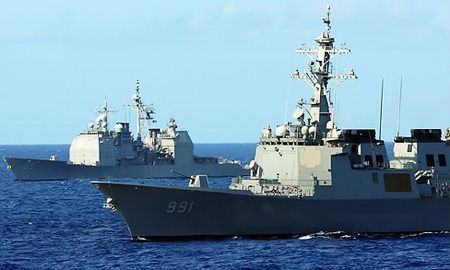
An Aegis destroyer Sejong the Great participates in the Rim of Pacific naval exercise in the waters off Hawaii in this July 2010 file photo. / Yonhap
The Peace Eye is equipped with a multi-role scanning radar, which includes two side-looking and top-hat arrays, giving 360 degrees of coverage.
A single aircraft, which is capable of tracking up to 1,000 airborne or surface targets simultaneously, can monitor the entire Korean Peninsula. The South has four Peace Eyes.
As a key Aegis combat system, the SPY-1 is a computer-controlled naval radar system. Using four complementary antennas, the cutting-edge equipment also provides 360-degree coverage.
The Green Pine is a ground-based missile-defense radar originally developed in Israel.
Last December when Pyongyang launched a rocket that it claimed was carrying a satellite, the SPY-1 was the first to detect it followed by the Peace Eye and the Green Pine.
It took 94 seconds for the SPY-1, 97 seconds for the Peace Eye and 120 seconds for the Green Pine.
“The North can fire its rocket either eastward or southward. Or, it might fire them in both directions at the same time. We are prepared for all scenarios,” the official said.
Pyongyang is believed to have moved missiles including the intermediate-range Musudan to its east coast recently, generating speculation it will fire them this week ahead of April 15, the birth date of the late Kim Il-sung, grandfather of current leader Kim Jong-un.
The day is the most significant holiday in the Stalinist country.
The Musudan can fly more than 3,000 kilometers so could reach all of South Korea and Japan as well as the U.S. territory of Guam.
In response, the U.S. has dispatched missile defense systems to the island to safeguard its military there.