Parties open talks on constitutional revision
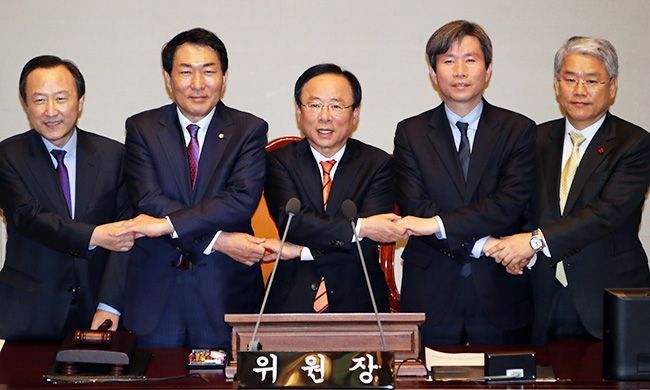
Rep. Lee Ju-young, center, the head of the National Assembly committee on revising the Constitution, holds hands with representatives of rival parties before its first meeting at the National Assembly, Thursday. From left are Reps. Hong Il-pyo of the New Conservative Party for Reform; Ahn Sang-soo of the Saenuri Party; Lee; Lee In-young of the Democratic Party of Korea; and Kim Dong-cheol of the minor opposition People’s Party. / Yonhap
By Kim Hyo-jin
The National Assembly kicked off bipartisan discussions on a constitutional revision aimed at limiting excessive presidential power, Thursday.
But a result is unlikely to come out soon as parties are squarely divided over when and how to amend the Constitution.
This is also because the issue is closely linked with a presidential election possibly slated for early this year. Depending on the timing, the term of the next President or the extent of his or her influence could be affected.
The main opposition Democratic Party of Korea (DPK), in line with the stance of its former leader and potential presidential candidate Moon Jae-in, remains reluctant to revise the power structure before the ballot while the ruling Saenuri Party and the minor parties are strongly pushing for it.
The 36 lawmakers of the National Assembly special panel for Constitutional revision held their first meeting, but tensions have already been detected among the participants.
The voice for early reform was notable among lawmakers of the Saenuri Party and the minor opposition People’s Party.
“Chances are high the legislators will put a halt to the imperial presidency and the winner-take-all election system,” Rep. Kim Dong-cheol of the People’s Party said.
“Some say we don’t have enough time but it’s just a matter of our will. We can expedite the process by channeling all our efforts into the work.”
Echoing Kim’s view, Rep. Ahn Sang-soo of the Saenuri Party said, “We should come up with a result before the upcoming poll. To do so, we may as well focus on mending the power structure.”
But DPK lawmaker Lee In-young said reluctantly, “I wish our discussions put more importance on content, rather than speed. We need to have comprehensive talk including the people’s basic rights and social reform.”
Even if the panel members could agree on the timing and putting the focus on the current power structure, hurdles also remain in how to decentralize the president’s power.
The lawmakers are also divided over a four-year, two-term presidency; a parliamentary system; or a semi-presidential system, under which the president would be responsible for foreign and national security affairs while the prime minister would be responsible for domestic affairs, which are being discussed as possible alternatives.
During the meeting, lawmakers from the Saenuri and People’s Party raised an offensive against the DPK, noting a controversy caused by the party’s internal document on Constitutional revision.
A local media outlet reported Tuesday that the document, made by DPK’s think-tank, advised the party to take a reluctant stance on talks about the revision and that it has been circulated among lawmakers close to Moon, the liberal front-runner.
“The discussions on constitutional reform should not be swayed by parties’ interests,” Rep. Song Ki-seok said, expressing regrets. “I suggest that we receive a pledge from the leadership of the parties that they shall respect and accept the result of the talks by the panel.”
With rival parties taking aim at the DPK and Moon over their reluctance for the constitutional revision, Moon is expected to present his official position on the issue.
“We are in the final stage of devising a pledge on the Constitution reform,” an aide to Moon said.
He said the pledge will stress expanding citizen rights, decentralizing power to the local governments and supporting balanced regional growth.
“Moon will not lay out the blueprint centering on the issue of the power structure,” he added.
A broad consensus has been built among the political circle about the need to change the current five-year single-term presidential system that allows unbridled power for an elected president.
The call was fueled in the wake of the country’s biggest corruption scandal involving President Park Geun-hye and her confidant Choi Soon-sil.
The rival parties agreed to set up a special panel to discuss a constitutional revision two days after the scandal-ridden President was impeached with support of over two-thirds of the 300 Assemblymen on Dec. 9. The panel will operate for six months.