PM's role crucial after impeachment
By Kang Seung-woo
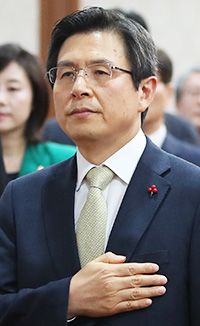
Prime Minister Hwang Kyo-ahn salutes the national flag ahead of a Cabinet meeting at the government complex in Seoul, Tuesday. / Yonhap
With the National Assembly highly anticipated to pass an impeachment motion against President Park Geun-hye, Friday, the role Prime Minister Hwang Kyo-ahn will play as acting head of state is drawing attention.
As the Constitution does not specify the role of the prime minister if a president is impeached, the government is expected to review previous cases to deal with state affairs.
The nation has seen four acting presidents in constitutional history, with its latest one, former Prime Minister Goh Kun, leading the country for 63 days in 2004 when former President Roh Moo-hyun was impeached.
“Even though the voting result is anyone’s guess, we are preparing for the passage of the motion,” said an official at the Prime Minister’s Office.
A large number of constitutionalists say that Hwang’s role should be kept to a minimum to maintain the status quo because a nominated prime minister cannot exert the same authority as an elected president.
In that respect, an interim leader is unauthorized to appoint Cabinet members, Supreme Court and Constitutional Court judges, let alone signing a pact or an agreement with other countries, they said.
If the impeachment motion succeeds, the Constitutional Court will review the case for up to 180 days. In addition, if at least six justices out of nine approve the impeachment, a presidential election will be held within two months.
“Given that an acting leader will only have up to eight months if impeachment occurs, it will be difficult for him to lead the country, ignoring President Park’s policies,” said a political analyst.
Therefore, Hwang is expected to follow in the footsteps of Goh who kept a low-key governing style as acting head of state.
Goh, focused on stopping the leadership vacuum, exercised the presidential role in a restrictive manner, only filling the posts of vice minister-level officials that had become vacant. In addition, he visited Cheong Wa Dae only once to present credentials to foreign ambassadors to Korea.
Goh also got the chief policy official to brief Roh about key state affairs, including an in-person report on security issues on a daily basis.
The main opposition Democratic Party of Korea is mixed on the acting leader’s role.
Some say that Hwang’s role should be kept to a minimum, so he only needs to focus on addressing the current political chaos, triggered by the corruption scandal involving Park and her confidant Choi Soon-sil.
However, others claim that the opposition bloc should join forces to replace Hwang, a key associate of Park, ahead of the impeachment vote in order to reform the government.
Should Hwang begin to serve as acting president, his first duty would be his attendance at a trilateral summit with Japan and China, scheduled for Dec. 19 and 20 in Tokyo.
Hwang attended the Asia-Pacific Economic Cooperation (APEC) summit in Peru last month on behalf of Park.
Questions will also remain on whether he can appoint new justices to the Constitutional Court as two of nine justices are scheduled to retire in January and March, respectively.
If Hwang refrains from expanding his role from that served by his predecessors, the two posts will be left empty and seven justices will have to deliberate on Park’s impeachment.