16 days of anguish
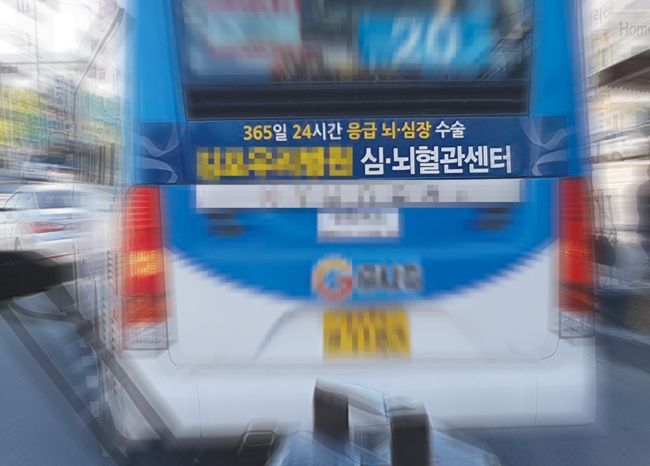
An ad for the Gimpo-based hospital on the back of the bus reads: “Brain and cardiac surgery available 24 hours a day, 365 days a year.” / Korea Times file
The following is a narrative article based on the reporter’s experience of taking care of her dying father and the frustrations she had with a local hospital. The people in the article are not named for privacy. — ED.
By Kang Hyun-kyung
My father was deep in sleep; In fact, he had been asleep since his second cardiac arrest on Oct. 12 during his medical evacuation from the intensive care unit to the general ward of a university hospital in western Seoul.
That evening, medical staff rushed to the eighth floor as my father showed signs of respiratory arrest in the absence of his doctor. They had performed CPR on him while he was transferred in a stretcher back to the ICU for the second time.
My father fell into a coma after the staff’s unsuccessful attempts to revive him and eventually passed away on Oct. 20.
He had been hospitalized for over two weeks following a stroke. He was recovering in the hospital and was anxious to return home to his normal life.
But just when we thought he was finally getting better, his condition took a turn for the worse. He did return home, but not in the way he had hoped.
My two younger brothers and I were allowed to see him briefly about an hour before he was gone. No words can describe the pain of seeing one’s dying father.
Father was fighting for life. The upper right part of his chest trembled visibly, and his left eye welled up. This made me think he wanted to say something to us so desperately, but he couldn’t utter a word because of his illness and this saddened him.
The nurse told us our visiting time is up and asked us to leave, a request we had to follow. An hour later, I was urgently ushered to the ICU again to see my father on his deathbed. The young female resident, who always accompanied my father’s doctor whenever he explained something about my father’s condition to us, was about to declare his death.
I asked if she could wait for 30 minutes or so until my two younger brothers, who had left the hospital earlier for work, optimistic about my father’s recovery, could say their last goodbyes.
She flatly rejected my request and went ahead with her duty. “At 7:13 a.m. on Oct. 20, 2016, Mr. Kang Nak-ho passed away,” she declared.
I was crushed. I was overcome by a wave of anger that I didn’t know I had inside of me.
I came closer to my father, touched his cold forehead and bid him farewell. “Thank you father for everything you’ve done for me. I’m sorry for letting this happen to you. Thank you for your patience. I hope you rest in peace.”
On Oct. 4, Father had a stroke in his medulla oblongata. Located at the lower base of the brain, the medulla is responsible for breathing, blood pressure regulation, heartbeat and swallowing.
His doctor at the university hospital said he had atrial fibrillation, an irregular heartbeat, which directly caused his medulla stroke. The doctor said the disease could be fatal and warned him of a second arrest, probably within two to three days, as with most medulla stroke patients.
The second cardiac arrest came on Oct. 12, six days after my father was transferred to the hospital in Seoul from the secondary hospital near our home in Gimpo, Gyeonggi Province.
He never woke up from the second arrest, which proved fatal. According to his doctor, the second arrest stopped blood from flowing to his vital organs for five minutes, leading to irreversible damage to his kidneys, among other organs. The doctor advised us to prepare for his death.
I prayed, “If my father would die, I hope the day would be sunny. I hope it will be daytime, not nighttime. Otherwise, the pain of loss that we, his family members, have to go through would be far greater.”
My prayer was heard. He survived the night of Oct. 19 and passed away the next morning after sunrise. With his own will, he appeared to have struggled to extend the pain of dying to make my last wish come true.
Accepting and confronting his tragic end was much harder than expected.
The last 16 days before his death were a rollercoaster ride. My father recovered fast after he was taken to the university hospital on Oct. 6, two days after he was diagnosed with a stroke at the hospital in Gimpo. I thought it would only be a matter of time for him to be discharged from the hospital because he looked even healthier than before he collapsed from the stroke. Thanks to the effective treatment at the university hospital, he looked well enough for his doctor to decide to evacuate him to the general ward.
Following his death, I wrestled with a tormenting question — what went wrong?
What if he was taken straight to the tertiary hospital in Seoul, not the secondary hospital near our apartment in Gimpo, when I first discovered him struggling from numbness in his legs and arms and from dizziness? Would that have saved his life?
I have no accurate answers to those questions because my medical knowledge is extremely limited. However, one thing is for sure — I would have had at least fewer regrets if he were taken to the tertiary hospital right away.
I found something wrong with my father around 8 p.m. on Oct. 4 when I returned home from work. I found him struggling to stand up to go to the restroom. I called 119, the number for emergency service here.
The 119 crew arrived about 15 to 20 minutes after the call, and took him to the emergency unit of the neighborhood hospital, which was only a 10-minute drive.
I told the rescue staff to take my father to the nearby hospital because it was the nearest one and I didn’t want him to miss the golden hours needed for surgery. All the nation’s major medical institutions, also known as the Big 5 hospitals, are located in Seoul, and reaching any of them would have required us to take the 88 Olympic Highway, which is notorious for traffic jams during commuting hours.
But choosing the nearby hospital turned out to be a disaster.
An array of medical mistakes awaited us. The medical staff there performed a blood test and a CT scan on my father, and we were briefed about the results over three hours after he was taken there.
The CT results came earlier that night, but the night shift doctor explained the results to us only after he finished treating other patients who had relatively minor injuries, such as cuts on their hands. The emergency doctor called us around 11:40 p.m., and as he showed us the CT scan, he said “fortunately,” my father had no stroke. But he said he was deeply concerned about the serious case of arteriosclerosis in his brain. The doctor recommended that my father be hospitalized for treatment, which we followed.
Days later, I learned that a stroke is not detected in CT scans. The emergency doctor should have ordered an MRI scan of my father to figure out whether he had a stroke or not.
The next morning, a neurologist, who became my father’s main doctor for the next two days, belatedly ordered an MRI scan of father, which showed he had a medulla stroke. Owing to the first doctor’s misdiagnosis and inefficient work style, the medical staff at the hospital missed the golden hours for surgery.
That same morning, the hospital served my father a regular breakfast. Weary, he said he had no appetite for it and didn’t eat it.
This was another critical mistake the hospital made. It turns out patients are required to fast for the first 24 hours after a stroke, and, depending on their health condition, they may fast an additional day or two upon doctors’ recommendation.
That evening, he went into cardiac arrest, and my two younger brothers and I were in shock. We were also frustrated because the neurologist never told us that such a dangerous situation could happen to our father after his stroke.
Before the cardiac arrest, the medical staff offered an optimistic view of my father’s condition and said one part of his medulla oblongata was impaired due to blood clots but he was fine because the other part was still working.
Upon our request, the hospital then arranged my father’s transfer to the university hospital in Seoul. However, it’s also questionable whether a transfer of a stroke patient who just had a cardiac arrest a day before was appropriate.
On my way to work to Seoul on Monday, I was bothered by an ad for the Gimpo-based hospital on the back of the bus in front of me as I sat in my car waiting for the traffic light to turn green.
It read: “Brain and cardiac surgery available 24 hours a day, 365 days a year.”
It made me wonder how the medical staff there can perform surgery when they are so incompetent they cannot diagnose their patients’ medical conditions accurately.