Trump Aftershock OPCON transfer may come earlier
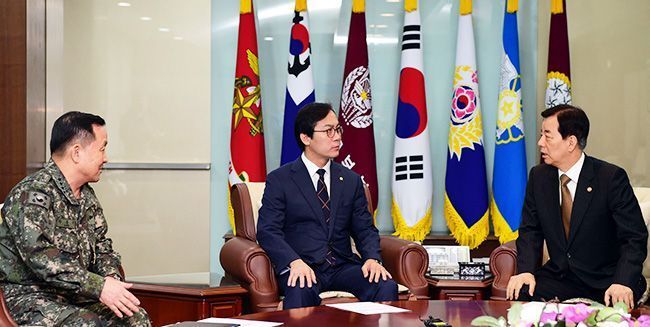
Saenuri Party lawmaker Kim Young-woo, center, head of the National Assembly Defense Committee, discusses security issues with Defense Minister Han Min-koo, right, and Joint Chiefs of Staff Chairman Lee Sun-jin at Lee’s office in Yongsan, Seoul, Thursday. / Yonhap
Park, Trump hold phone conversation
By Kang Seung-woo
The election of Donald Trump as the next Anerican president is expected to hasten the transfer of the U.S. wartime operational control (OPCON) of South Korean forces to Seoul in an effort to save defense costs, analysts here said Thursday.
Conservative governments of South Korea have repeatedly delayed taking over the OPCON transfer to the mid-2020s, citing growing North Korean nuclear threats and South Korea’s “unpreparedness” for a North Korean attack.
However, given the president-elect’s negative stance on the U.S. security commitment to the Korean Peninsula on his country’s defense budget, he is expected to call for more South Korean burden-sharing, or he may seek to complete the transfer much earlier than planned.
South Korea handed over both wartime and peacetime operational control of its armed forces to the United States in July 1950, a month after North Korea started the Korean War. Seoul regained peacetime operational control in late 1994.
“It is a feasible scenario under the Trump administration due to his unpredictable and variable foreign policy,” said Park Won-gon, an international relations professor at Handong Global University.
“Trump may first urge South Korea to pay more for the presence of the U.S. Forces Korea (USFK), but if it does not turn out as he wishes, he may push to hasten the OPCON transfer as well as reduce the number of American troops stationed here in order to lower costs.”
During his election campaign, the billionaire-turned-politician often expressed his opinion that South Korea gives nothing in return for more than 28,000 American soldiers stationed on the peninsula ― although Seoul pays about 50 percent of the total cost estimated to be around 2 trillion won under the five-year special measures agreement (SMA). Last year, Seoul paid 932 billion won.
“Based on his words from the campaign, Trump’s stance is to ask why the United States is protecting rich South Korea on the U.S. defense budget and he may decide to transfer the OPCON during his term in office,” Park said.
Victor Cha, Korea chairman at the Center for Strategic and International Studies, echoed Park’s view.
“Trump’s guiding principle has been to put American interests first. In this regard, it is entirely plausible that a Trump presidency may seek to complete the OPCON transfer and put these responsibilities in the hands of Koreans,” he said
Cha, who was former President George W. Bush’s top adviser on North Korea, also said that the SMA is the first substantive alliance issue that is likely to come up during the Trump presidency.
“The cost-sharing agreement will require renegotiation in 2017. Trump has said clearly during the campaign that allies need to pay their share. Expect the United States to drive a hard bargain in renegotiations,” he said.
Meanwhile, the U.S. President-elect held a phone conversation with President Park Geun-hye, reaffirming Washington’s security commitment to the peninsula, Thursday, according to Cheong Wa Dae.
“We are with you all the way and we will not waver,” Trump said during the 10-minute talk.
Stressing the ROK-U.S. alliance that has lasted for over 60 years, Park said North Korea’s nuclear issue is the greatest threat facing the two nations and called for close cooperation on the issue.
“We will be steadfast and strong with respect to working with you to protect against the instability in North Korea,” Trump said.
Park also hoped that Trump will visit South Korea in the near future, the presidential office said.
In order to effectively handle possible changes in the bilateral ties, the foreign ministry has formed a task force.
On Wednesday night, Foreign Minister Yun Byung-se presided over a meeting that discussed the effects the incoming U.S. government will have on South Korea and sought ways to set up communication channels with the Trump camp.
In addition, the ministry is mulling over sending a vice minister-level official to Washington to consult with the Trump side about North Korea issues.
On Thursday, the North Korean regime issued a warning to Trump, reaffirming that it will not give up its nuclear ambitions.
“Washington’s hope for North Korea's denuclearization is an outdated illusion,” the Rodong Sinmun, the mouthpiece of the ruling Workers’ Party, said.
The newspaper added that U.S. President Barack Obama’s “strategic patience” policy with North Korea has only left bigger burdens for his successor as Pyongyang has become a nuclear state.