Park urges facilities for more N. Korea defectors
By Kang Seung-woo
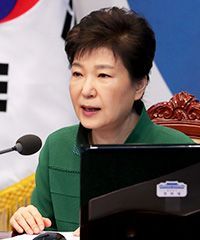
President Park Geun-hye speaks during a Cabinet video conference with the Sejong Government Complex from Cheong Wa Dae in Seoul, Tuesday. / Yonhap
President Park Geun-hye said Tuesday that the country should be fully prepared to help North Korean refugees settle down here, describing them as a “testing ground” for unification.
“The North Korean elite as well as its ordinary people, who are frustrated by the regime, are increasingly fleeing the country, so it is very important to help them live a stable life in South Korea, which will give hope to North Koreans who are troubled by their dictatorial regime,” Park said during a Cabinet meeting at Cheong Wa Dae.
She called on relevant government offices to build facilities to accommodate more North Korean defectors and review a system to better support their resettlement.
“The defectors are like a precursor to unification, and handling them is like a trial run for eventual unification,” she added
Her remarks are regarded as a follow-up measure to her Armed Forces Day speech, Oct. 1, when she urged North Koreans ― rank-and-file troops and citizens ― to abandon their country and defect to the “bosom of freedom” in the South.
In addition, according to a recent media report, the government plans to build a refugee village to accommodate 100,000 North Koreans in the event of a sudden change in the North.
This year, more ranking North Korean officials have defected from the repressive state, which some analysts view as a sign of instability within the Kim Jong-un regime.
Thae Yong-ho, a former deputy ambassador in London, fled to South Korea in August, becoming the most senior North Korean official to defect in nearly two decades. Another high-ranking North Korean embassy official in Beijing who was in charge of supplying medicine to the North Korean leader has arrived in Seoul, as well.
In response to the opposition’s criticism that the President’s defection speeches are prompting North Korea to take provocative actions, Park said such arguments were not conducive to addressing the North Korean nuclear issue and were “twisted.”
“Such arguments will prevent international cooperation on the North Korea nuclear program,” she said, asking the opposition parties to put the foremost priority on the wellbeing of citizens and “muster up the strength” for the betterment of the nation and its descendants.
Park also made it clear that her administration will continue to press North Korea rather than engaging the isolated state in order to curtail its nuclear ambitions.
“Sticking to dialogue would be tantamount to jeopardizing the safety of South Koreans and allowing Pyongyang to stall for time,” she said.
“In order to coerce the North Korean regime to change its behavior and end its nuclear weapons program, we have to focus on sanctions and pressure on the country.”
Park also warned that the North could face further diplomatic isolation ― even from its few remaining friends ― if it continues to develop nuclear weapons.
“The North’s efforts to keep basic diplomatic relations with the outside world will be difficult as the current contours of the international community versus North Korea will be solidified, not to mention stronger sanctions,” she said.
Kim Young-ran Act
In addition, President Park told relevant ministers to take action to minimize any side effects from the nation’s new anti-graft law amid speculation that it may hamper economic recovery due to sluggish consumption.
“The law is the people’s promise and code of conduct to end irregular practices that lead to corruption, and to forge a transparent and clean society through fair competition,” she said.
“We should not let the purpose of the law fade or only highlight its side effects by excessively responding to it.”
The so-called Kim Young-ran Act went into effect Sept. 28 and bans public officials, journalists and teachers from being treated to meals costing more than 30,000 won ($26.7), and receiving more than 50,000 won in gifts or money for congratulations and condolences exceeding 100,000 won.
Critics have said it will dampen consumption and undermine a long-standing culture that features exchanges of gifts and meals as an expression of hospitality, gratitude or affection toward one another.