Concerns grow over wild boars in cities
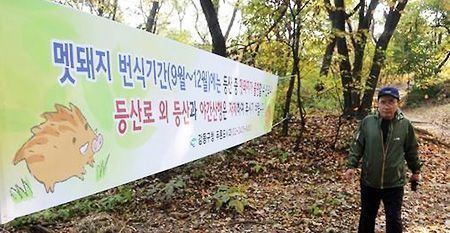
A banner on a mountain in Gangdong-gu, eastern Seoul, warns hikers not to walk at night or stray off designated trails due to wild boars, in this November file photo. / Yonhap
Animals invade residential areas in search of food
By Lee Kyung-min
A growing number of wild boars are encroaching on urban residential areas, causing financial damage or injuries.
While local and central authorities try to catch those that are reported, they are not easy to catch and their numbers are ever increasing.
According to the Ministry of Public Safety and Security, some 1,700 emergency calls were made nationwide for wild boar sightings last year, rising from 2011 and 2014 when the number of reports ranged between 600 and 800.
In Seoul alone, 155 wild boar sightings were reported, according to the Seoul Metropolitan Government (SMG). Of them, 88 percent, or 137 reports, were made in six districts bordering Mount Bukhan, including Jongno, Eunpyeong and Seongbuk. In the first half of this year, Seoul had 80 reports, about one every two days.
They mostly cause property damage but often attack people too.
According to the Ministry of Environment, 44 percent of the total 10.6 billion won ($9.6 million) in agricultural damage incurred by wild animals was caused by wild boars.
In July, a wild boar wreaked havoc in a restaurant in Uijeongbu, Gyeonggi Province, running over tables and chasing out customers.
Last month in Busan, a wild boar attacked a 65-year-old woman in the street. She was treated at a hospital. Last November, a trekker died after being attacked and bitten in the thigh by one boar in North Gyeongsang Province.
Experts say wild boars come down to residential areas due to a lack of food in their mountainous habitats.
“We advise people to dispose of food waste regularly because the animals mainly come down in search of things to eat,” said an official at the Mount Bukhan unit of the Korea National Park Service (KNPS).
The number of wild boars coming to residential areas is expected to increase along with the rise in their numbers, the official said.
“Usually, more than half of the piglets die due to heavy rains during the summer rainy season, but most of them managed to survive over the past three years when the precipitation was low,” he said. “Also, they currently have no natural enemy as more ferocious animals in the country’s food chain including wolves and tigers went extinct.”
To prevent damage from boar attacks, the central and local governments have moved to capture ― or kill, if necessary ― wild boars. Upon citizens’ reports of wild boar sightings, the authorities contact shotgun owners who work as volunteers to catch the animals under the municipalities’ supervision. Captured animals are sent to Seoul National University or the National Institute of Environmental Research for study.
The animals are often killed during capture, but this is not the preferred way to reduce their numbers, according to the authorities.
“They are live animals,” the KNPS official said. “To kill them only to eliminate human inconvenience is a self-centered mindset that hurts the natural ecosystem.”
So, to prevent wild boars from encroaching on cities, the Ministry of Environment, SMG, and the KNPS’s Mount Bukhan unit launched a joint project dubbed “Let boars live in mountain areas” in March.
While SMG uses traps to catch them, the KNPS set up a 220-meter fence near Gugi Tunnel in Jongno at a cost of 40 million won. If proven effective, the government may allocate a budget to set up more fences next year, the official said.