Baek's death certificate escalates dispute
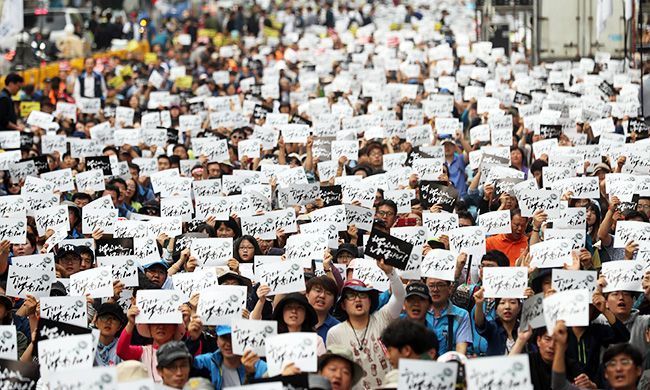
Protesters rally in Daehangno, Seoul, Saturday, to condemn the authorities’ move to carry out an autopsy on the late Baek Nam-ki, a farmer who died on Sept. 25 after being put in a coma by a police water cannon during an anti-government rally last November. The participants hold signs that say, “We are Baek Nam-ki.” / Yonhap
By Chung Hyun-chae
Disputes are heating up over the phase "cardiopulmonary arrest" on the death certificate of a farmer who died after being sprayed by police water cannon during an anti-government rally last November.
Seoul National University Hospital (SNUH) issued a death certificate for Baek Nam-ki, 69, who died Sept. 25 after spending 10 months in a coma after being hit by the water cannon, which gave the cause of the death as cardiopulmonary arrest, not an extrinsic trauma.
Baek’s bereaved family and a committee representing them claimed that Baek died from injuries caused by the water cannon, condemning the death certificate.
According to guidelines on how to write a death certificate which were published by Statistics Korea in 2014, the certificate should describe the specific cause of death or the name of the disease, not just entering conditions accompanied by the death.
Such conditions include cardiac arrest, respiration arrest and respiratory failure.
“There is also video footage that recorded the rally where Baek was hit by the police water cannon, which can prove that injuries from the water cannon caused his death,” the committee said.
The hospital has yet to announce its official position on this matter, only saying it will explain Baek’s death certificate at the National Assembly audit on Oct. 14.
“I acknowledge that some have raised suspicions that there must have been some outside pressure when issuing Baek’s death certificate, but I can say with confidence that there was no influence at all,” said Suh Chang-suk, president and CEO of SNUH. “I assume that a physician in charge of Baek made his own decision in writing Baek’s death certificate.”
The Korean Medical Association did not give an official response to the matter either, saying it is reckless to announce an official position before police and court make their conclusions.
But they reportedly said that writing cardiopulmonary arrest on a death certificate as the cause of the death is far from unlikely.
Police have maintained their stance that an autopsy could determine the exact cause of Baek’s death, which also could settle the issue.
The court accepted the second request by police and prosecution for a warrant for an autopsy, but added that the authorities should negotiate with bereaved family members on how to conduct the autopsy.
With regard to the snowballing suspicions about Baek’s death certificate, 102 enrolled students of Seoul National University College of Medicine released a statement on Sept. 30, calling for the hospital’s explanation.
“According to the forensic medicine lecture we have taken at the university, Baek’s death was undoubtedly caused by injuries,” the students said in the statement.
In response to this, 365 alumni also released a statement that admitted that Baek’s death certificate goes against the basic principle of death certificates.