Speaker says he did nothing wrong
By Kang Seung-woo
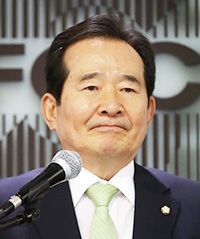
Chung Sye-kyun
National Assembly Speaker Chung Sye-kyun dismissed a call to resign from Lee Jung-hyun, chairman of the ruling Saenuri Party, Wednesday.
Chung reaffirmed his unwavering stance against the ruling party during a Wednesday luncheon with foreign journalists, hosted by the Seoul Foreign Correspondents’ Club.
On Lee, Chung said “He is a member of the National Assembly, so I should respect him and can hold talks with him if necessary. However, my counterparts are floor leaders, not party leaders.”
The ruling party leader, who started a hunger strike Monday, has demanded Chung’s resignation, claiming Chung broke political neutrality and sided with opposition parties last week in the passage of a no-confidence motion against the newly appointed agriculture minister.
“As the Assembly speaker, I must remain neutral. Otherwise, I must be held responsible for not doing so. But I have never violated the Constitution or the law of the National Assembly,” Chung said.
Chung urged the governing party to return to the Assembly audit.
“The audit sessions are an important undertaking for the legislative branch to keep the executive branch in check,” he said. “They are for the people, not for the political parties. The ruling party should return to the audit.”
In order to bring back the Saenuri lawmakers, two opposition floor leaders ― Woo Sang-ho of the Minjoo Party of Korea and Park Jie-won of the People’s Party ― suggested that Chung express his regret over the no-confidence motion, but the speaker made it clear that he would not.
“Although I worked hard to prevent the motion from being tabled, it was anyway. If so, my obligation is to handle it, otherwise it is a dereliction of duty,” he said, adding the motion was legitimate and he has no further comment on the ruling party’s claim.
Regarding the planned deployment of the U.S. Terminal High Altitude Area Defense (THAAD) battery here, Chung said the government should have sought opinions from the Assembly before making any decision.
Chung also stressed the need for the government to fully communicate with the people, while making diplomatic efforts to address Chinese and Russian opposition to the system’s presence on the Korean Peninsula.
“There should be no absence of democratic procedures,” he said, hinting that the government needs to win legislative approval for the deployment.