Regulatory hurdles too high for drone users
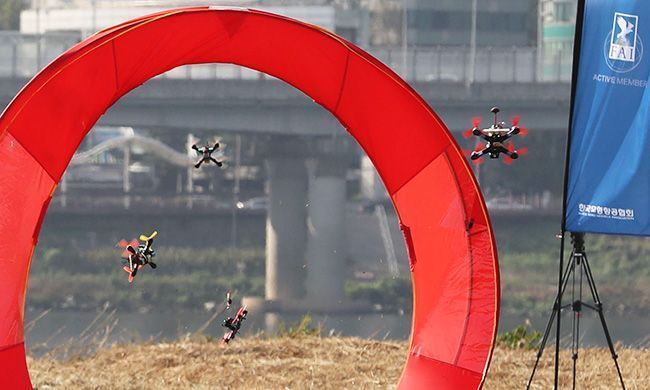
Drones fly during a racing competition at Gwangnaru Hangang Park in eastern Seoul, Sunday. The park is one of 18 designated spots in Korea where people can fly drones without reporting to related authorities. To gain permission to fly elsewhere, users have to report the purpose, location and time. / Yonhap
By Choi Ha-young
On Aug. 28, police caught a film crew making a music video for popular K-pop boy band 2PM flying a drone on Kyung Hee University’s Seoul campus without approval. The team faces up to 2 million won ($1,815) in fines because the school campus is a drone no-fly zone, like most of other areas in Seoul.
A growing number of people use drones for either business or leisure, but face strict and complicated regulations here, preventing active use of the flying devices and shackling the related industry’s development.
The Ministry of Land, Infrastructure and Transport requires people buying drones heavier than 12 kilograms to register the machines with regional aviation administrative bodies immediately after purchase. Even drones lighter than 12 kilograms are subject to registration should they be intended for business purposes.
However, many drone users opt not to register their machines due to the tough regulations.
“When I bought a drone to shoot a video, I had to prove that I was running a business,” said a 31-year-old video maker surnamed Kim.
The government recently lifted a rule requiring drone users to prove that they have 45 million won in the bank to register the machines with the authorities.
With the lifting of the rule, Kim now plans to register his drone. Still, he has one more step before flying it outside — drone operators must report to the related authorities when and where they will fly drones and for what purpose.
In Seoul, flyers must contact the Air Defense Operation Control Post under the Capital Defense Command at (02) 524-0310-3.
Reporting is required, even for hobbyists, unless they fly the drones in special zones. But these zones are very limited, with only 18 locations in the whole country, and four of them in or near Seoul. The locations around Seoul are open spaces near the northern end of Gayang Bridge, Sinjeong Bridge in southwestern Seoul, Gwangnaru Hangang Park and Byeollae Interchange in Namyangju right outside Seoul.
To fly drones outside those 18 spots, users must report four to seven days in advance, with the required days differing from region to region.
Further, even in the 18 permitted locations, if the drone pilots want to record video, the Korean Defense Intelligence Agency under the Ministry of National Defense (MND) must approve it. The approval is available via phone at (02) 748-2344.
Due to this complicated process, lots of drone pilots are confused. “These days, customers want to film videos within one or two days. As the authorities demand prior reports four to seven days before, it’s hard to set schedules,” Kim said.
Another blogger surnamed Sung shared his experience receiving authorization from four different organizations: the Seoul Regional Aviation Administration, the Capital Defense Command, the MND and the Defense Security Command. “It would be much easier to carry out the process via internet, not fax, and integrate the authorities in charge,” he wrote.
Like means of transportation, it is illegal to fly drones when intoxicated. Also, when visibility is low due to pollution or fog, pilots must take more care not to let their drones fly out of view. They are also required to not fly drones in crowded areas such as sports complexes or festival venues for safety concerns. Drones also cannot exceed an altitude higher than 150 meters from the ground.
“It’s easy to fly over 150 meters when running a drone,” said office worker Im Yeon-joon, 26. “It’s very difficult to enjoy drone flying as a hobby. There is so much paperwork to do for a few hours of enjoying a hobby.”
Sources in the industry say under such restrictions, drone-related businesses such as delivery systems are unlikely to develop in Korea. One expert said the restrictions are a common problem in other countries, including the U.S. “For delivery, Amazon also initially faced a regulation that a drone should stay within the pilot’s sight,” said Jung Sung-wook, a researcher at KAIST’s robot engineering department.
Jung said easing drone-related regulations is becoming a worldwide trend. “Korea needs to establish a legal foundation step by step to develop the local drone industry,” he added.