Gyeongju may become disaster area
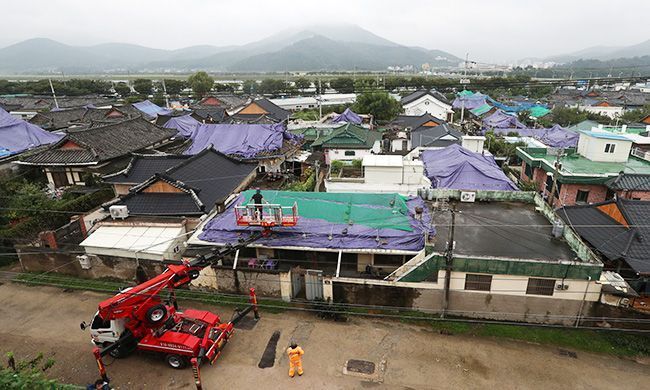
Workers cover the roofs of houses damaged by two earthquakes last week with plastic sheeting in preparation for a typhoon approaching the city, Sunday. Heavy rain expected in the area could delay the recovery process. / Yonhap
By Kim Se-jeong
The government and ruling Saenuri Party are considering designating the southeastern city of Gyeongju, which was hit by two strong earthquakes last Monday, as a special disaster area.
The quakes ― measured at magnitudes 5.1 and 5.8 ― were centered near the historic city, the location of many cultural heritage sites. The magnitude-5.8 quake was the strongest ever recorded in Korea. Gyeongju experienced more than 350 aftershocks until Sunday.
The quake took no lives, but caused dozens of injuries. According to North Gyeongsang Province, seven still remain hospitalized.
The central government on Sunday released an emergency relief fund totaling 4 billion won to the governments of Gyeongju and nearby affected areas.
At a meeting with government policymakers at the National Assembly, Saenuri Party Chairman Lee Jung-hyun said, “Please consider declaring Gyeongju a special disaster area if qualifications are met following a comprehensive onsite study.”
Gyeongju is the ancient capital of Silla (B.C. 57 - 935 A.D.) and is a popular tourist destination. “The quake was strong enough to be felt throughout the rest of the country, a good reminder of the danger of earthquakes. Emergency aid funds need to be given to residents immediately,” Lee said.
Government officials said that Gyeongju could be designated as a disaster area if the total damage tops 7.5 billion won, which will entitle the residents to emergency relief and special administrative and financial support.
According to the provincial government, 4,438 cases of damage have been reported to the authorities between Sept. 12 and Sunday morning.
The most common damage was to the roofs of hanok, or traditional Korean houses. Also common was damage on walls and cracks on buildings. The famous Buddhist temple Bulguksa had part of its roof damaged as well.
Recovery efforts were suspended during the Chuseok long weekend because of Typhoon Malakas, which is approaching the Korean Peninsula from the south.
Almost 180 millimeters of rain fell in the region during the holiday period until Sunday. According to the weather agency, Gyeongju will continue to be affected by the typhoon which will be 90 kilometers southwest of Osaka, Japan, by Sept. 21.
Over 1,000 volunteers, soldiers and local government officials gathered there over the weekend to cover rooftops and heritage sites with plastic to keep them dry from the rain.
Park In-yong, the minister of public safety and security, visited the affected city Saturday, pledging the government’s support in the recovery process. Interior Minister Hong Yun-sik was also in the affected area on Sunday.