Court rulings ignite feuds among doctors
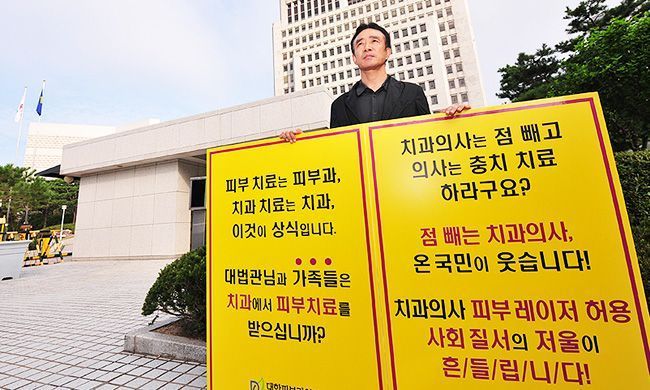
Kim Bang-soon, chairman of the Association of Korean Dermatologists, stages a one-man rally in front of the Supreme Court in southern Seoul, Monday, to protest the court ruling that allows dentists to use dermatological laser equipment. / Yonhap
Doctors in different fields in feuds over ‘expertise’
By Lee Kyung-min
Conflicts are deepening among doctors specializing in different fields, following recent court rulings that allowed medical practitioners to provide treatments which were previously regarded as being in others’ domains.
Doctors whose specialties are likely to be weakened protested the rulings, while those whose specialties are likely to benefit from the decisions claim such permission will widen patients’ options.
On Aug. 29, the Supreme Court acquitted a dentist of using a Fraxel Laser, a dermatological device that helps reduce fine lines and dark spots on the skin of a patient. It said the dermatological treatments are within dental expertise.
The ruling came about a month after the top court overturned a lower court ruling and allowed dentists to give Botox shots to patients to remove wrinkles around their eyes.
Dermatologists and plastic surgeons opposed the ruling.
On Monday, Kim Bang-soon, the chairman of the Association of Korean Dermatologists (AKD), began a one-man protest in front of the Supreme Court, saying the ruling confuses the public about which medical professional they should see for a particular health concern.
Kim held a sign that read: “Common sense dictates that dermatologists treat patients with skin problems, and dentists, problems with their teeth. Allowing dentists to use dermatological equipment disrupts the social norm.”
Kim said dentists should not be allowed to treat patients with skin problems because they do not have proper training to diagnose these conditions based on what appears on the patients’ skin.
“Dermatologists are trained to decide whether a patient requires a simple laser treatment for the removal of a mole or if they have something that requires further tests and observation for possible cancer or other serious diseases. Such diagnosis is impossible without years of in-depth, professional knowledge about skin,” an AKD official said.
“Further, those without training using laser equipment could cause an increase in medical accidents where affected patients might suffer from scars or other side effects,” she added.
Protesting against the ruling, dermatologists said they would begin teeth whitening treatment.
The Korean Association of Plastic Surgeons (KAPS) also criticized the top court’s ruling, saying it failed to recognize the role of a licensed dentist defined by law.
“The law clearly stipulates that a dentist should treat patients with oral health concerns. The court ruling is based on the premise that the term ‘oral’ includes eyes, ears, nose, cheeks and forehead. This is not only uncommon but a bizarre interpretation of the law. Such a definition of the medical term ‘oral’ is nowhere to be found in any credible medical references,” the KAPS said in a statement.
“Rulings of this sort undermine the authority and credibility of state-administered medical licenses, further jeopardizing public health,” it added.
Contrary to these responses, the Korean Dental Association welcomed the rulings on laser and Botox treatments.
“The decision on laser treatments is in line with that of Botox treatments. It again confirmed that treatment of the face is within a dentist’s expertise,” the association said in a statement. “We hope doctors’ groups will halt their legal fight and stop making distorted claims about the domain of dentists. They should commit themselves to their duties.”
Earlier in August, a high court also ruled that Oriental medicine practitioners should be allowed to use the electroencephalograph (EEG), a brain-wave measuring machine used to assist in the diagnosis of dementia and Parkinson’s disease, fueling the practitioners’ conflicts with medical doctors.
The court said using the EEG does not require specific clinical experience and thus Oriental medicine practitioners can use the device to understand patients’ conditions, saying using the machine is within the limits of their licenses.