New MPK leader visits gravesite of ex-President Park
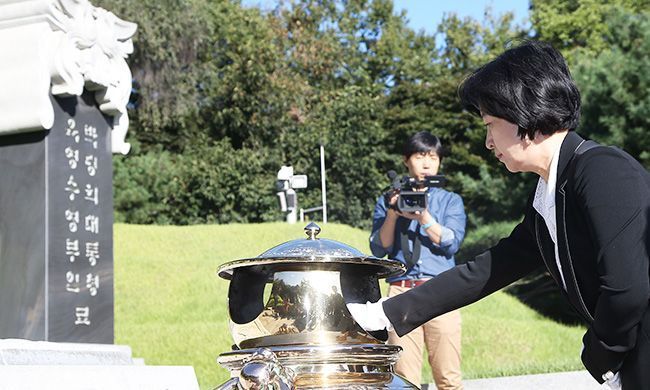
Rep. Choo Mi-ae, the newly elected chairwoman of the main opposition Minjoo Party of Korea (MPK), pays tribute to ex-President Park Chung-hee, father of President Park Geun-hye, at his gravesite in Seoul National Cemetery, Monday. / Yonhap
By Kim Hyo-jin
Rep. Choo Mi-ae, the newly-elected chairwoman of the main opposition Minjoo Party of Korea (MPK), visited the gravesites of former presidents, including Park Chung-hee, the father of incumbent leader Park Geun-hye, Monday.
The visit is an apparent bid to promote an image of the party embracing both conservative and liberal voters.
Choo paid tribute to not only ex-Presidents Kim Dae-jung and Kim Young-sam but also to Kim Gu, who led Korea’s government in exile during Japanese rule and Presidents Park Chung-hee and Syngman Rhee at the Seoul National Cemetery.
Eight Supreme Council members accompanied her, making a full entourage of party leadership.
The move drew much attention as it came after Choo vowed to clarify the party’s stance as a strong opposition party, heralding a tougher stance against the governing bloc.
It is rare for an opposition leader to pay homage to the late conservative Presidents who have been given a cold shoulder from liberals for backpedalling on democratization.
Pundits view that the visit was made to discolor the party’s image of downplaying the nation’s industrial age while Choo is seeking to expand the support base among conservatives and liberals ahead of the presidential election next year.
“We have our own mission in each age,” Choo told reporters after paying tribute.
“Today’s mission is public unity and the improvement of people’s livelihoods. I came here to pray for help and renew my determination.”
Party officials viewed the visit as a sign of strong leadership by Choo. The Supreme Council members said they accepted her suggestion in support for her stress on the importance of national unity.
Rep. Moon Jae-in, the former party chairman, also visited the ex-Presidents’ grave sites in February last year after he was elected party leader. But the entire Supreme Council was absent in opposition to his decision then.
Party officials said the visit was intended to send a message to the ruling bloc that it should not stir division based on political orientation.
“We respect the public call that the political sphere should be united,” Choo said during the first party meeting later that day. “I hope President Park Geun-hye would do the same by participating in a ceremony marking the anniversary of the May 18 Gwangju Uprising in 1980 and the Jeju Uprising in 1948.”
Choo delivered a similar message at a meeting with Rep. Lee Jung-hyun, her ruling party counterpart, and National Assembly Speaker Chung Sye-kyun.
“I hope you pay attention to my voice, taking it as the public voice,” she told Lee, calling for bipartisan cooperation. Lee responded positively, saying, “I will also seek cooperation from you especially on the matter of people’s livelihoods.”
Choo, widely referred to as a key figure of the so-called Moon Jae-in faction, is anticipated to play crucial role in paving the way for Moon to launch a bid for the 2017 presidential election.
Conscious of concerns that Moon will become a monopoly in the primary race under the pro-Moon leadership, she reportedly made calls to other potential contenders Rep. Kim Boo-kyum, Seoul Mayor Park Won-soon, South Chungcheong Governor Ahn Hee-jung, and Seongnam Mayor Lee Jae-myung, sharing her determination as the new leader.