"Insects emerge as food of the future"
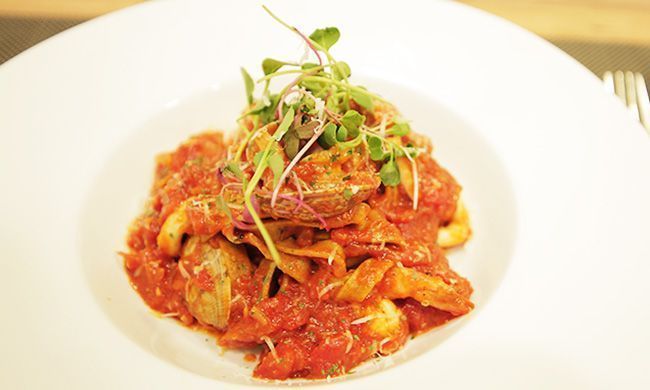
Papillon’s Kitchen serves seafood tomato pasta, above, and other dishes. / Courtesy of Papillon’s Kitchen
By Kim Se-jeong

Kim Yong-wook
Papillon’s Kitchen, a small restaurant in central Seoul, sells pastas, salad and croquettes, among other dishes.
It is unique because the restaurant uses powder and syrup made from mealworms as ingredients. It is one of Korea’s first restaurants serving food made with edible insects.
Edible insects, with high nutrition, are gaining attention because they are emerging as future sources of food around the world.
Since the restaurant’s opening last year, the one-table establishment has become popular — so much so that it requires a reservation at least a month in advance.
“People enjoy the dishes,” the restaurant owner, Kim Yong-wook, 40, said. “It’s not like the insects are served without being processed, which can be disgusting to some.”
Customers at the restaurant are diverse. Recently, it’s been mainly children, and their number skyrocketed after the restaurant was featured in a children’s science magazine.
Businessmen and officials from the government and the presidential office also came with curiosity, Kim said. “Those who find out about it come out of curiosity or for possible business ideas.”
Kim, who was a professor teaching hospitality, heard about edible insects at a conference in the United Kingdom in 2012. “It hit me hard,” he said.
The popularity of Papillon’s Kitchen means more than business success. The success projects a better future for Korea, which faces a food security challenge.
Internationally, research is active about edible insects, such as grasshoppers and crickets, as future food sources — some even study cockroaches.
The Food and Agriculture Organization of the United Nations (FAO) has endorsed edible insects as a reliable source of human food.
Edible insects are “high in protein and good fats and high in calcium, iron and zinc,” according to the FAO’s 2013 report, Edible Insects: Future Prospects for Food and Feed Security. “Using insects as food can help increase dietary quality when including animal sources of protein,” the report said.
Eating insects is also environmentally friendly.
According to the U.N., obtaining a kilogram of edible insects requires two kilograms of feed, while eight kilograms of feed is needed to produce the same amount of beef, which emits a lot of greenhouse gases.
Kim said edible insects will solve problems for Korea, which does not have good food security.
The country imports most of its staples, except for rice. Garlic is the only vegetable Korea grows enough to export. Worse is that the government did not have a long-term strategy for food security, and climate change is expected to worsen the situation.
Early this year, the government listed two insects as edible, to make the total five — grasshoppers, silkworm pupa, still silkworms, mealworms and crickets.
This is part of an effort to encourage farmers to breed more insects. There are almost 400 farms that breed insects in Korea. There are a couple of companies that sell insect powder, and another couple that make cookies from the powder.
Not just preparing and selling food, Kim is busy searching for farmers, who can supply insects for cooking.
Kim and his colleagues also continue studying insects. The Korean Edible Insect Foundation, which he founded, aims to develop new forms of ingredients, other than powder and syrup.
“Insects are nutritiously perfect,” he said. “And they are almost the only source of food left that humans have not used.”