Nowhere to fly

An oriental stork from Chungram Stork Park at Korea National University of Education in Cheongju, North Chungcheong Province / Courtesy of Institute for Oriental Stork Ecology
By Ko Dong-hwan
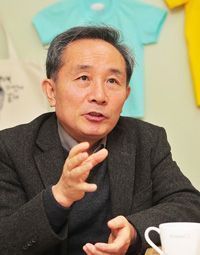
Park Shi-ryong
Korea’s most reputable stork expert, Park Shi-ryong, is not optimistic about releasing into nature more of the oriental storks he has been breeding for the past 20 years. “Not yet,” he said in an interview with The Korea Times. The odds of the birds – which were extinct on the Korean Peninsula -- repopulating the nation’s rice paddies and wetlands are low because the species’ main hunting grounds are mostly toxic with herbicides and pesticides.
“There should be a plenty of prey in rice paddy habitats for the birds to feed on,” said the professor from Korea National University of Education in Cheongju, North Chungcheong Province. “But now there aren’t many places for the birds to live. Ninety percent of rice paddies nationwide use toxic chemicals that deter storks’ main sources of food like fish, frogs, snakes and aquatic insects.”
In April, Park stopped breeding storks as two main breeding grounds -- Chungram Stork Park, inside the school campus, and Yesan Stork Village in Yesan County, South Chungcheong Province -- are at capacity with 160 storks. Park wants to release into nature 60 storks from Yesan Stork Village but their natural habitats outside their cages have not yet been prepared.
Ideal habitats can be naturally formed by “stork-friendly rice farming.” Developed in Japan, where a stork reintroduction project started 10 years before Korea, the chemical-free farming produces high-quality rice and develops an ideal environment for storks by attracting diverse prey the birds feed on. The farming also contributed to Japan’s profound ecological diversity in rice paddies and wetlands, breeding about 5,000 species -- compared with 200 in Korea, where the farming is not yet practiced.
To build such fertile habitats, help from the Yesan County government and farmers is needed. But they are yet to understand the importance of this type of farming. Cultural Heritage Administration, a government body funding Park’s stork reintroduction project, has cut off funds this year, a blow to the professor who is anxious to let the caged storks free.
“I’m in dilemma now,” said Park, also the director of the Institute for Oriental Stork Ecology. “When I retire next year, I will move to an office in Yesan and prepare a campaign to persuade the head of the county office and local citizens to employ the stork-friendly rice farming. Storks cannot be restored without their help because the birds live where people live. Persuading them will take time but it must be done.”
In Yesan County, some 80 kilometers west of the school, authorities are busy building natural habitats for storks, rearranging the natural environment in Gwangsi village, through which the Moohan stream from Yedang Reservoir runs. But construction is slower than Park expected and the work could be delayed to 2025.
“Gwangsi, Sinyang and Daesul villages in Yesan have been designated as eco-friendly farming zones,” said Park Jung-ho, head of the Culture and Tourism Department in the county office. “As our long-term goal, we are now recovering Moohan stream’s upstream environment.”
The official knows who Prof. Park is and is well aware of how anxious he is to see the habitats completed. “The professor demands the construction be finished fast,” the official said. “But it cannot be done that way. It’s not simple work but a large-scale job costing the county’s budget of 5 billion won ($4.4 million). Such work takes time.”
The official said he had never heard of stork-friendly rice farming. “Because of a lack of manpower, our county uses pesticides only once a year,” he said, hinting that chemical-free farming is not up for consideration.
The professor’s passion for storks is rooted deeper than simply reviving the birds -- national monument No. 199 -- which number about 2,500 worldwide. His work aims to raise awareness about “ecological ethics,” which emphasize co-existence of humans and nature.
“In Europe, you dig in soil and there were many earthworms,” said the professor, who studied ethology in Bonn, Germany, in 1981-87. He still remembers the country’s great affluence in contrast to poverty-stricken Korea back then, as well as well-preserved natural environments in German suburban areas. “When you drive, you could see so many insects popping against the windshield that you had to wipe them off frequently. In Korea, you don’t see many earthworms and insects any more, even in the countryside. It’s because of the uncontrolled use of toxic chemicals.
“Korea is still underdeveloped in terms of ecological conscience. They use pesticides 21 times that of Canada per acre, five times America and three times Japan. Koreans don’t want to see the bugs and kill them. Their selfish ecological ethics must be changed.”
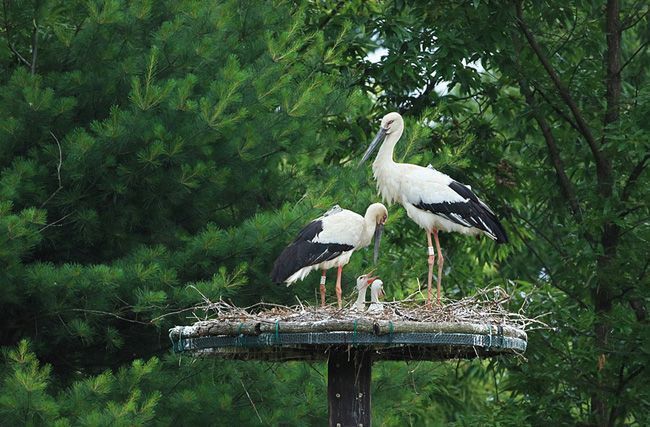
Two storks reintroduced into nature from Yesan Stork Village in Yesan County, South Chungcheong Province, in September 2015 tend two youngsters hatched in May. The young birds are the first storks hatched in the natural environment in Korea since 1971. / Courtesy of Institute for Oriental Stork Ecology
Extinction to regeneration
As of October 2014, there are 246 endangered species in Korea, according to the National Institute of Biological Resources, an arm of the Ministry of Environment. Among those on what is known as the Korea Red List, 51 are categorized as “Level 1,” requiring more urgent care than the rest of “Level 2” species. Twelve species, including storks, in Level 1 are birds. As with the Protection and Management of Wildlife Act, storks are one of 43 species the government designated in 2011 to reintroduce to nature.
In 2001, the ministry selected Korea National University of Education as an ex-situ conservation institute, an acknowledgement of Park’s stork regeneration project that began in 1996. Park started the project with five young storks brought from Germany. The Cultural Heritage Administration funded the deal and TV broadcaster MBC featured the story in a documentary. Park brought 16 more storks from outside Korea up to 2006.
In May, Park’s project had a landmark accomplishment as two of eight storks released into nature from Yesan Stork Village in September 2015 hatched two youngsters, the first natural hatching in Korea since 1971.
“I was like a mother discovering my daughter, with her husband, had given birth to a healthy baby,” Park said.
Park had invited President Park Geun-hye and the former presidential chief of staff Kim Ki-choon to the stork release event, but they didn’t respond. Their attitude is in contrast to Japan, where in 2005 the Japanese Emperor’s son and daughter-in-law participated in the world’s first stork-reintroduction event in Toyooka, Hyogo Prefecture, along with 3,500 supporters from across the world.
“The president’s moves always attract national interest,” Park said, explaining her presence at the event would have drawn public attention to his lifetime project.
Including five birds released from Yesan Stork Village on July 18, there are now 14 reintroduced storks in Korea, across Chungcheong and Jeolla provinces. Park will stop releasing the storks until their habitats are ready next year.
“Japan reintroduced 21 storks in 10 years, which has increased to 86,” Park said. “In Korea, 19 were released in just two years. They must increase to 70 to 80 to secure their perpetual survival but, without the habitats, it’s impossible.”
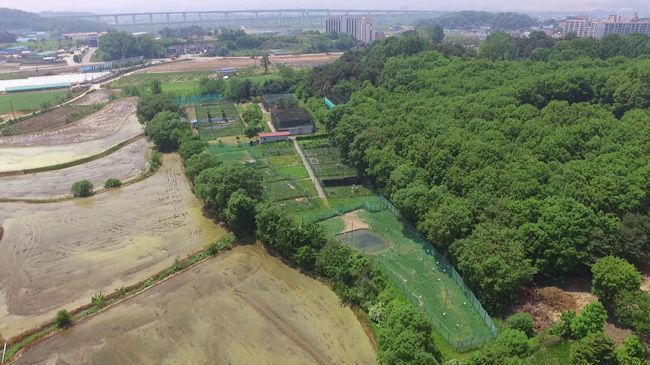
Chungram Stork Park inside the Korea National University of Education campus and its surrounds in Cheongju, North Chungcheong Province, from a bird’s eye view. / Courtesy of Institute for Oriental Stork Ecology
Effort fledges to N. Korea
Producing oil paintings of storks roaming in nature in his free time, Park’s imaginative birds also flutter over the inter-Korean border. The professor will turn the thought into reality by flying the birds to the hermit state, with the North’s cooperation, thereby bringing the two Koreas closer.
The idea was formed after one of the reintroduced storks -- “K0003” -- with a GPS tracker, travelled to North Korea for nine days in March. It visited the cities of Gaesong, Haeju and Kaepoong, Anak counties in Hwanghae Province next to the border and, following its homing instinct, flew back to Yesan Stork Village.
“Since North Korea is so isolated, storks could be a channel for inter-Korean trade with the least political sentiment,” Park said. “The unification may come with ecological trades.”
Park’s dissertation, “A New Strategy for Oriental Stork Reintroduction in Korean Peninsula and Restoration of the Habitats in DMZ and Hwanghae-do in North Korea,” was introduced in the ECOSOS Newsletter published by his research institute in 2015. Park shared the paper with a professor from the General Association of Korean Residents in Japan -- known as Chongryon, which represents North Korean interests in Tokyo -- who will re-enter North Korea. Park said in the study he will establish a research facility and a stork habitat at Gyodong Village, next to the Northern Limitation Line in Ganghwa County, Incheon, and start releasing GPS-tracked storks annually from next year. Using their location information, he will designate North Korean spots suitable for habitats -- the demilitarized zone and Yeonbaek Coastal Plain, for instance -- and, with consent from the North, will work with North Korean scientists to build the habitats and employ stork-friendly rice farming there.
“If the North assents, we can change their agriculture,” Park said.
Park’s singular efforts naturally attracted other birds to a forest established near Chungram Stork Park. In 1996, with the onset of the stork-breeding project, the school banned herbicides and pesticides on the 130,000 square-meter site. Twenty years on, the site has grown thick with trees and teems with insects, becoming a habitat for more birds than before -- from 73 species in 2001 to 126 in 2015. Brown hawk-owls and scops owls, natural monuments No. 324 and No. 324-6, respectively, also reside there. The school has erected 150 four-meter-high nests around the forest where some 80 tits of the paridae family live and hatch.
“At first insects started to nibble on the trees and leaves but I waited,” said Park, who will reintroduce this year seven endangered saunders' gulls that he has been breeding in Songdo, Incheon. “The trees then began to form immunity against the insects and grew to become a forest.”
Park eventually wants to reintroduce 50 stork mating pairs. They will need at least 15,000 hectares of wetlands to live but for now he will start with renting 150 hectares near the school. He hopes donations from members of the Stork Club, a community of stork-loving people founded in June, will cover the rent.
“I will present each donor one of my paintings,” said Park. “Where storks cannot live, eventually people cannot live either.”