Deadly car accident prompts debate on driving test system
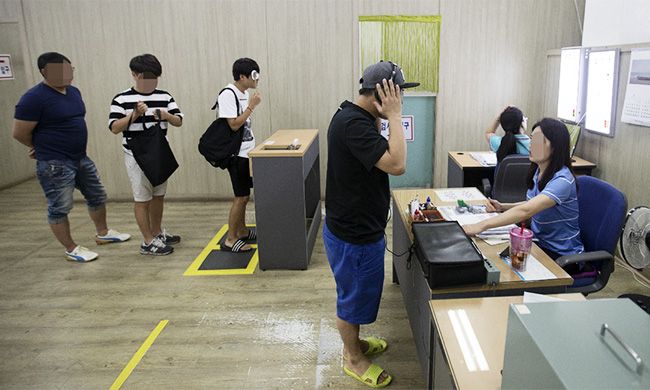
Applicants get their vision and hearing checked at the driving test center in Gangnam, southern Seoul, Thursday. The current test system fails to filter those with mental health problems unless they voluntarily report it. / Yonhap
System fails to filter applicants with mental conditions
By Kim Se-jeong
The deadly car accident in Busan last month by an epilepsy patient is raising questions about the nation’s driving test system that allowed the driver with a inhibitive medical condition to be behind the wheel.
It showed the system needs to be revised to prevent similar accidents, but it is not easy because of a controversy over privacy.
The accident on July 31 in downtown Busan killed three and injured 21. The police in Busan confirmed the driver was an epilepsy patient who had passed out several times previously, while they are still investigating whether he passed out as well at the time of the accident. They also found he had renewed his driver’s license just last month.
Epilepsy is a neurological disorder, often accompanied by epileptic seizures.
While epilepsy or dementia patients can cause car accidents when their conditions are not well managed, such people as well as alcohol or drug addicts can obtain driver’s license due to lax implementations of the law.
Under the current law, such people are banned from obtaining driver’s license. But they are allowed when they submit a doctors’ opinion that they have been treated and a review committee of the Korea Road Traffic Authority (KoRoad) allows it.
But in reality, it is difficult to know whether driver’s license applicants have such conditions unless they voluntarily report it to the authority. Applicants are asked about their medical conditions on the application form and those who lie are subject to a fine up to 3 million won or imprisonment for up to one year, but hardly anyone gets caught.
Some argue the driver’s license test authorities should be given access to applicants’ medical records archived in the National Health Insurance Service (NHIS) to filter the unqualified. The National Police Agency is pushing for it and Rep. Ha Tae-keung of the ruling Saenuri Party based in Busan pledged to come up with a new bill concerning that after Sunday’s accident.
But such a move faces hurdles.
The Personal Information Protection Act states that it’s illegal for an institute to share personal data with other organizations without the person’s consent. Other laws regarding medicine say the sharing of medical information should not infringe on privacy.
“Sharing personal information, especially medical records, is a violation of human rights,” Hong Seung-bong from the Korean Epilepsy Society said.
He also questioned the credibility of medical records, citing a recommendation by the national rights commission in 2002, when the commission said the past medical record could tell little about the current condition. It said there are possibilities that the patients would have improved or healed.
It also pointed out that the number of people with mental health problems unregistered with medical authorities would be high.
Cheon Yong-hwan, official from the KoRoad, said it’s time for debate.
“Under the current system, there’s no way for us to identify those with disorders unless they voluntarily come forward. It’s time for debates.”
The driver of the Busan accident initially told the police that he went unconscious and did not remember anything as he skipped medication in the morning. Yet, the police later discovered that he had caused another hit-and-run several minutes before and was escaping from the scene, raising suspicion about his testimony.