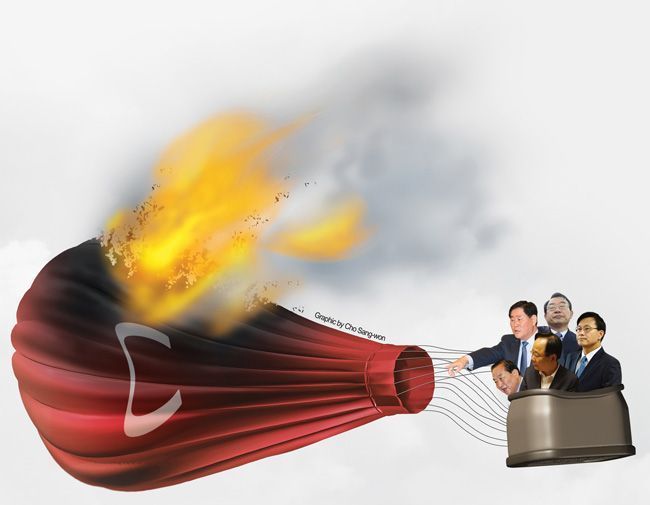
Demise of Park loyalists
By Kim Hyo-jin
With the ruling Saenuri Party set to elect its new leader at a party caucus on Aug. 9, a sense of crisis is palpable among those who are loyal to President Park Geun-hye.
The cold reality facing the faction, which has long dominated party affairs, is that Park is increasingly losing popularity among party members. The faction could disintegrate before the party begins to select its candidate for the presidential election in late 2017.
And the party caucus could be the starting point for a power shift toward those who have kept their distance from Park and her followers. Those who do not follow Park will emerge as major power-holders in the leadership race, political pundits say.
They say there is no contending chairman candidate from the pro-Park faction among those who have launched their bids.
With Reps. Suh Chung-won, an eight-term lawmaker, and Choi Kyung-hwan, former finance minister and de-facto leader of Park loyalists, out of the race, the faction’s chances of winning are slim.
Worse, it was hit too hard to recover following the disclosure of phone recordings by a local broadcaster that unveiled influence-peddling practices by its members during the run-up to the April 13 general election.
Park is expected to lose her grip on state affairs in the 17 months remaining in her term while her followers are pushed away from the center of party politics.
“Starting from the end of the chairmanship election, Park followers will seek to break free from the title of Park loyalists to cope with a new power structure,” said Park Myung-ho, a politics professor at Dongguk University.
“They followed Park due to political interests, not ideological similarities. They will realign themselves in pursuit of their own bigger interests."
He stated that lame duck status has already hit the President and has instigated an internal division within the faction.
In the lead-up to the leadership race, multiple pro-Park members _ Reps. Lee Jung-hyun, former senior presidential secretary for public relations; ex-maritime minister Lee Ju-young; and Han Sun-kyo _ launched their bids, showing no signs of joining hands.
They are seeking to wash off the title of Park loyalist, distancing themselves from the rest of the faction.
Lee Ju-young vowed to hold accountable those responsible for the party’s defeat in the April elections, most of which are pro-Park members. Lee Jung-hyun refused collective support from the faction, saying, “I politely decline any sort of endorsement on my candidacy” on a Facebook post.
“Since the stinging defeat in the general election, Park has lost her grip on the party,” said Hwang Tae-soon, a senior analyst at Wisdom Center.
“With a prospect that the President won’t be the momentum for the party winning the next presidential election, pro-Park lawmakers are seeking their own means of survival.”
Anti-president rhetoric has become apparent in the Saenuri Party. Pro-Park lawmakers do not function as her safety net anymore.
It is notable that criticism of the President accounts for a significant part in a party report in an analysis of the defeat in the April 13 general election.
In the 300-page report published last week, Park’s self-righteous style in managing state affairs and working with the governing party was noted as a major cause of the defeat.
Rep. Choung Byoung-gug, a chairman candidate who does not follow Park, pointed out the changed atmosphere, saying, "Park followers are now passing the buck to the President."
“It’s been a repeating pattern that a mainstream faction backing the president withers as a presidential tenure reaches its end,” analyst Yoon Tae-gon at Moa Agenda Strategy said, likening the situation to the previous Lee Myung-bak administration.
“But, the outlook of the pro-Park faction's longevity is more dismal because Park has only tightened her grip on her followers without nurturing a number two or three. Members will come apart so easily in her lame duck period.”
Presidential election
Pundits say the power structure in the ruling party will be rearranged after the chairmanship ballot, with lawmakers coalescing around potential contenders to run in the 2017 presidential election.
Ex-chairman Rep. Kim Moo-sung and former Seoul Mayor Oh Se-hoon are expected to rise as major players in the new setting. Gyeonggi Province Governor Nam Kyung-pil, Jeju governor Won Hee-ryong, and Rep. Na Kyung-won, former chairwoman of the National Assembly Foreign Affairs and Unification Committee will also gain traction.
Rep. Yoo Seong-min, party's former floor leader who was estranged from Park, will also be able to expand his influence.
All of them are not Park followers.
“With no potential contender in the pro-Park faction, its members will be left rudderless. They will eventually turn against her and join hands with Kim or Oh,” Yoon said.
Park loyalists have courted United Nations Secretary-General Ban Ki-moon to their side. Ban has responded positively, hinting at a potential presidential bid.
Speculation is running high that he will act on this after his term expires at the end of the year.
“As Park loyalists’ influence is waning, Ban is left in a difficult situation,” Shin Yul, a political science professor at Myongji University, said.
Ban might need some time to fit himself into the ruling party which non-Park followers will take grip on, he views.
“Park and her followers losing ground offered the remaining ruling party members breathing space in breeding potential presidential candidates at their discretion,” Hwang said. “Before, a person backed by the president was highly likely to lead the run-up to the presidential race, but not anymore.”
Lee Jin-gon, the head of the Saenuri Party ethics committee, noted that a sense of crisis prevails in the party with speculations that it might fail to gain power again in the 2017 race.
He believes it can be momentum for the party to overcome factional division.
“Until the chairmanship election, the pro-Park faction might still be operating while their members appeal for votes. But if such a practice continues even after the intra-party competition, the dream of winning the presidential election will be shattered," he said. "Lawmakers must be aware of the risk."