INTERVIEW Is it wrong to eat dog meat?
.jpg?w=728)
British animal rights activists Madeline Warren, left, and Lucia Barber protest against Korea’s dog meat culture at the Gwanghwamun Plaza in central Seoul, Wednesday. / Courtesy of SaveKoreaDogs
By Park Si-soo, Lee Jin-a
Let’s make it clear, Korea’s dog meat eating culture is waning. The number of dog meat eaters is declining and so are the related restaurants.
As of late 2014, Seoul had 329 restaurants selling dog meat soup, “bo-shin-tang,” down 40 percent from 528 in 2005. So it is wrong to make sweeping criticisms of Korea over this issue, calling its citizens “dog-eating barbarians,” as portrayed by French actress Brigitte Bardot in 2012.
Every country has unique elements in its culture and lifestyle that deserve respect, as long as they do not damage the universal dignity of human beings.
At the same time, the spectrum of “dignity” continues to extend, throwing weight behind activists calling for putting the dignity of animals, especially companion animals such as dogs, on an equal footing with people.
Will this escalating conflict see its end someday? Is it possible to find a wise solution that can please those on both sides of the aisle?
As bystanders with a neutral position on this issue, The Korea Times reporters recently sat down in central Seoul with anti-dog meat campaigners from Britain. Lucia Barber, 29, and Madeline Warren, 46, are volunteers for SaveKoreanDogs. They are visiting Seoul, staging protests against Korea’s dog meat eating culture.
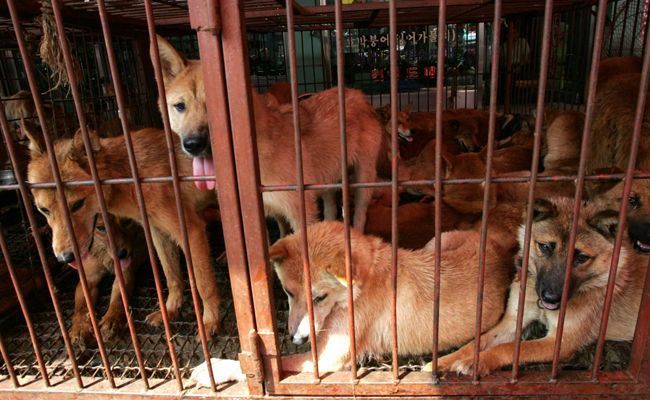
Dogs are held in a cage while awaiting slaughter at Moran Market in Seongnam, Gyeonggi Province, on Aug. 9, 2006. / Korea Times File
Q.
Do you think eating dog meat is wrong?
A.
Madeline: Yes. I think Koreans should refrain from it.
Lucia: Yes, I think it’s wrong and people should refrain from it. People shouldn’t do it. End of story. We think it’s wrong.
Why do you think it’s wrong?
Lucia: It’s cruel. Animals are suffering. The manner in which they are killed is inexcusable. That’s that, basically. It’s cruel.
What is cruel?
Lucia: It causes lots of suffering for the animals. They are suffering.
Cruel elements found in the process of slaughtering?
Lucia: Yes.
Madeline: The dogs are tortured before they are killed, because they believe the more the animal suffers, the better the meat will taste. If they are beaten, that softens the meat. And the more an animal has fear, the more important the medicinal properties of their meat will be. It is a very, very cruel way to kill animals.
What if the process is strictly controlled so that dogs can die with dignity?
Lucia: I disagree that animals can be killed in a dignified way. I don’t agree with killing animals, personally, any animal.
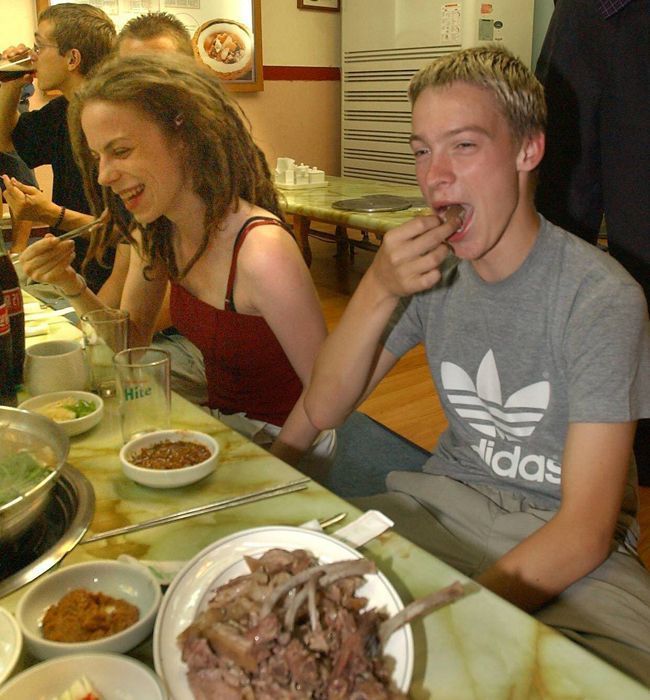
German taekwondo players tried dog meat at a restaurant in Seoul while they were visiting the country for training on July 30, 2003. / Korea Times file
Madeline, a vegetarian, said there is a conceptual line drawn to divide animals into two groups - what humans can eat and can’t. “We should not eat elephants and dolphins, giraffe. And I also think dogs are one of the animals that humans should not eat because we have a very special relationship with dogs.”
The definition of “line” is quite subjective. That definition can be varied in different cultures, and even people.
Lucia: Dogs are very (prevalent) around the world. Many people keep them as pets. Even in Korea, they keep them as pets. They are well domesticated. So even for that reason, alone, I think for most people, dog would be the right side of the line. And most people don’t eat dog.
The number of people eating dog is declining in Korea, making the people part of a minor group with unique taste. Every society has unique minority groups and their uniqueness should be respected. Can you be generous enough to embrace them as a minority with unique taste?
Madeline: Rapists are minorities. I don’t think being bad is a good thing to embrace. There are lots of things that are minor. That is not good.
Lucia: It is suffering by another living being.
What about in light of embracing social and cultural diversity?
Madeline: I embrace good diversity, I cannot embrace bad diversity. I cannot embrace it. No.
Many people who support dog eating think people who are against dog meat lack respect for a different culture. What do you think about that?
Madeline: I love Korean culture. I love Korean people but there is no perfect country.

Members of Korea Animal Rights Advocates staged a performance in front of the Government Complex in Sejong City to protest against dog meat on July 20, 2006. / Korea Times File
Do you think dog meat eating should be outlawed?
Madeline: Banning is not always a perfect way to do things. It can have a backlash. Chicago made foie gras illegal. But sales of it went up because people thought it is very funny and naughty to eat it. Nevertheless, banning it was a good start.
Such a law, if enacted, could run the risk of infringing on people’s freedom of eating.
Lucia: Freedom of eating? Are you saying it is OK to eat babies? Cannibals. So I should have freedom to eat you.
What about the risk of restricting people’s freedom of pursuing happiness?
Lucia: Find another way to be happy without torturing and murdering another living being.
Madeline: What about the dog’s happiness?
As a vegetarian, do you think people who do not eat dog meat and eat other animals are hypocritical?
Lucia: I think we each should just be aware that for that person, that is just where they put their line. They feel it is OK to eat non-domesticated animals, but a dog they feel differently about. I don’t have the same opinion as them but I can understand why.
Madeline: I think the word “hypocrite” is used quite a lot in these kinds of questions, and I think some people say unless you are absolutely perfect, you never stand at one end, on anything, then you are a hypocrite. But I think if you love some animals and protect some animals, that is as good with me. You don’t have to protect all the animals. If you protect some animals, then it is still a very good thing to do.
What is your plan in line with this campaign?
Madeline: I have got in touch with some newspapers in the United States and the U.K. to write some news articles for them. In my articles, I am very much seeing Korean people as very nice. Most of them do not want this to happen. I am very positive about Korea. People who are against dog meat need help to make a final push to make it illegal. It is these kinds of articles that I am writing.