Patience running out with Park
By Jun Ji-hye
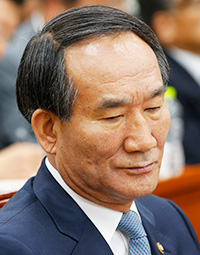
Park Sung-choon
Patriots and Veterans Affairs Minister Park Sung-choon is facing mounting calls to resign after he defended the ministry’s earlier decision to confer a posthumous decoration on a relative of North Korean founder Kim Il-sung during a National Assembly session, Tuesday.
Amid escalating public criticism,the ministry said Wednesday it will find a way to cancel the award. Critics said the minister does not know how to conduct policies, and his flip-flop attitude only causes social unrest and division.
During the session, Park said that there was no problem in the ministry’s 2012 conferment of the decoration on Kang Jin-sok, brother of Kim’s mother, Kang Pan-sok, as Kang had died in 1942 before Kim founded the North’s ruling Workers’ Party in 1945.
The decoration was conferred for Kang’s contributions to the nation’s independence movement against the Japanese occupation (1910-1945), according to the ministry.
“Kang died before 1945 so he was not related to the North Korean regime,” Minister Park answered as Rep. Park Yong-jin of the main opposition Minjoo Party of Korea (MPK) called the decoration into question.
The lawmaker said the ministry did not cancel the decoration even after it recently confirmed the relation between Kim and Kang.
When other opposition lawmakers asked the minister whether the ministry can then confer decorations on Kim’s parents, he answered, “I will give consideration to it,” causing further controversy.
Park was already embroiled in a number of controversies for what opposition lawmakers claimed was damaging political neutrality in handling issues related to veterans and victims of state violence.
The latest in a series of controversies was his recent request for a budget increase for an ongoing project to educate children and teenagers as well as civil servants about “national security.”
Opposition lawmakers say that through the project,the ministry has been promoting an ideologically biased view toward conservatives about historical events.
Three opposition parties submitted a joint resolution to the Assembly on June 23, calling on President Park Geun-hye to dismiss Minister Park, claiming that he did not fulfill the basic duties of a government official as he “severely damaged the political neutrality of civil servants.”
They cited that the minister, a retired Army lieutenant-general, “insulted the spirit of the May 18 democratic uprising held in Gwangju in 1980” by planning to hold a controversial military parade in the city to commemorate the 1950-53 Korean War.
At the time, the minister included the Army’s 11th Airborne Special Forces Brigade in the parade, despite its role in suppressing the pro-democracy movement, during which hundreds of civilians were killed and wounded by the military.
Earlier controversies involved the ministry’s decision last month not to accept the symbolic pro-democracy song, "Nimeul Wihan Haengjingok" (March for the Beloved), as the official song for a government-led memorial service for the pro-democracy movement in Gwangju.
Because of the decision, Minister Park was barred from taking part in the ceremony by the relatives of those killed by soldiers.