MPK to designate Assembly speaker
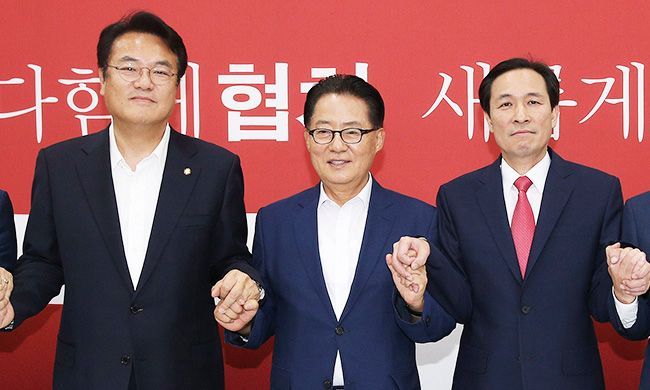
From left, floor leaders of the Saenuri Party, Chung Jin-suk; Park Jie-won of the People’s Party; and Woo Sang-ho of the Minjoo Party of Korea pose after they reached an agreement on how to form the new parliament at the National Assembly, Wednesday. / Yonhap
By Kim Hyo-jin
The rival parties agreed Wednesday that the main opposition Minjoo Party of Korea (MPK) will appoint the new speaker of the National Assembly.
They also came to a consensus on details for the formation of the new parliament including picking who will head the 18 Assembly committees.
Floor and vice floor leaders of the three parties ― the ruling Saenuri Party, the minor opposition People’s Party and the MPK ― sat together at the National Assembly one day after passing the statutory deadline.
“The MPK will fill the speaker post and the Saenuri Party and the People’s Party will designate vice speakers, respectively,” the parties vice floor leaders said during a press briefing after the deal was struck.
They added that the election of the speaker and vice speakers would be held at 2 p.m. today.
Of the entire 18 Assembly committees, they agreed to have the Saenuri Party and the MPK take eight chairmanships each, and the minor opposition People’s Party, two.
The negotiations have been stalled over a week as the ruling and main opposition parties wrangled over the ownership of the speaker post.
While the MPK insisted on the right to take the post as the largest party of the new Assembly, the Saenuri Party did not budge, arguing that the seat belongs to the ruling party.
Rep. Suh Chung-won, an eight-term lawmaker of the Saenuri Party who has been cited as a potential candidate for speaker, helped break the deadlock in negotiations after he called on the party to yield the post to the opposition and officially drop the chairmanship bid.
Mindful of worsening public criticism, he urged the negotiators not to delay the opening of the Assembly anymore and “look at the bigger picture.”
The ruling party handed over the post to the MPK and, in turn, secured the head posts of the much-wanted steering, legislation and judiciary committees.
It also took the chairs of the finance, national policy, administration, science, intelligence and defense committees.
Meanwhile, the MPK took the chairs of budget and accounts, labor, foreign affairs, welfare, transport, agriculture, gender equality and ethics committees. The second-largest opposition People’s Party secured the education and trade committees.
The parties also agreed to hold the opening ceremony of the 20th National Assembly on June 13, and later that day, to elect chairpersons of the Assembly committees.
The agreement came nine days after the 20th National Assembly was officially inaugurated, May 31.
Although belated, it would bring the fastest opening of the Assembly in about three decades since the revision to the Constitution in 1987.
The openings of the 13th to 19th Assembly were delayed on average by 51.2 days due to a tug-of-war between rival parties on how to distribute key posts.
In the 14th Assembly, which set the latest record, it took 125 days until its actual opening.