Kim Jong-un declares NK a nuclear state
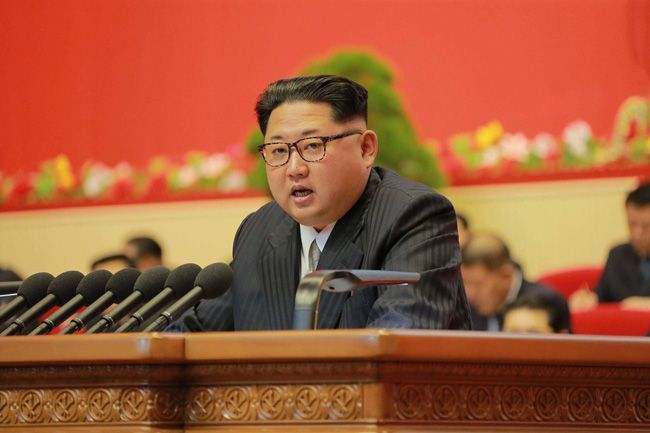
North Korean leader Kim Jong-un delivers a speech at the party congress of the Workers’ Party of Korea held in Pyongyang, Saturday. Kim vowed not to use nuclear weapons first unless the country’s sovereignty is violated at the key party congress. / AFP-Yonhap
Denuclearization remark seen as tactic for talks with US
By Jun Ji-hye
North Korean leader Kim Jong-un said that his country will not use nuclear weapons first unless the regime’s sovereignty is violated, declaring the isolated nation a nuclear weapons state, according to the North’s state media Sunday.
His remarks at the ongoing seventh Workers’ Party Congress came at a time when South Korea is bracing for a possible fifth nuclear test by the regime, following a fourth test in January.
Kim also said his regime will strive to achieve global denuclearization.
“As a responsible nuclear weapons state, our republic will not use a nuclear weapon unless its sovereignty is encroached upon by any aggressive hostile forces with nuclear weapons,” Kim was quoted as saying by the Korean Central News Agency (KCNA). “It will faithfully fulfill its obligation for non-proliferation and strive for global denuclearization.”
Regarding inter-Korean relations, the young leader, believed to be 33 years old, said that an urgent task for now was to fundamentally improve relations between the two Koreas to open a new chapter for unification.
He made the remarks during the rare party congress. The event kicked off Friday, 36 years after the previous event took place in 1980 under the rule of Kim Il-sung, the grandfather of Kim Jong-un.
This is the first time that Kim has spoken of denuclearization since he inherited the leadership of the nation following the sudden death of his father Kim Jong-il in late 2011.
Kim also suggested holding the South-North military talks, saying that such talks are necessary to ease tension on the Korean Peninsula.
Kim then unveiled a five-year plan to boost economic growth, stressing the need to increase its electricity supply. However, the economic plan lacked details, according to experts.
Nothing more than propaganda
The South Korean government downplayed Kim’s remarks, saying that he clearly indicated his intention not to denuclearize. The government said his statement meant that he will not abandon the nuclear program unless the whole world does so.
“There was no positive message regarding the North’s nuclear program,” a government official told reporters on the condition of anonymity. “The North just maintained its existing demand that the world accept the North as a nuclear power state.”
The government also rejected the North’s offer for inter-Korean military dialogue, branding it as sheer propaganda with no authenticity.
“The North’s proposal is merely a propaganda drive with no sincerity as it speaks of inter-Korean dialogue while continuing to develop a nuclear arsenal,” the unification ministry said in a statement, pointing out that the North has not halted its provocations against the South.
Experts say that Kim’s mention of denuclearization should be construed as an attempt to pave the way for negotiations toward disarmament and a peace treaty with the United States, rather than sincerely declaring the abandonment of its nuclear ambitions.
“Kim said ‘global denuclearization,’ not ‘denuclearization on the Korean Peninsula,’” Lee In-bae, a director of the Korean Peninsula Future Forum, told reporters. “I believe Kim intended to lay the groundwork for an arms control agreement with the U.S. It is hard to interpret the remarks as saying that the regime will give up its nuclear weapons. It will be necessary to wait and see the North’s next moves.”
Experts also said that Kim apparently made a diplomatic gesture, by mentioning denuclearization and unification between the two Koreas, as a means to seek an exit strategy from harsher sanctions imposed by the international community.
“Kim has apparently tried to open the sluice gate for the regime to engage in dialogue before international sanctions become even tougher,” Kim Yong-hyun, a professor of North Korean studies at Dongguk University, told reporters.
The United Nations Security Council (UNSC) imposed the harshest sanctions yet on the Kim regime in early March for the isolationist’s state’s fourth nuclear test in January and a long-range rocket launch in February. Unilateral sanctions from major countries including the U.S. followed afterward.
The party congress has been taking place amid growing speculation that the repressive state may carry out an additional nuclear test. But Kim’s mention of denuclearization apparently reduced the possibility of an additional test, according to experts.
Touching on external relations, the North’s leader said Pyongyang is open to improving ties with what the North calls hostile forces.
“The the Workers’ Party and the DPRK government will improve and normalize relations with those countries that respect the sovereignty of the DPRK and are friendly towards it, though they have been hostile toward it in the past,” Kim was quoted as saying.
The DPRK stands for the Democratic People’s Republic of Korea, the North's official name.