Disinfectant scandal pushes gov't to monitor all biocides
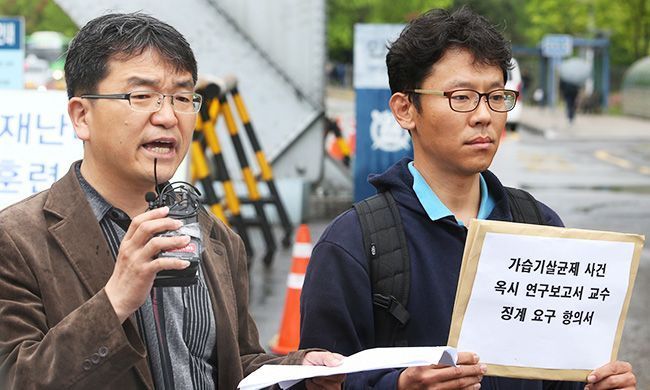
Kang Chan-ho, left, who lost a family member to a deadly humidifier disinfectant, calls for Seoul National University to take disciplinary action against its professors who were allegedly bribed by Oxy Reckitt Benckiser to falsify and cover up test results to show the company’s product was safe, during a press conference in front of the school’s southern Seoul campus, Tuesday. / Yonhap
Disinfectant scandal leads to tighter chemical control
By Kim Se-jeong
The Ministry of Environment said Tuesday it will conduct research on all biocides sold in Korea and list them and their manufacturers in an effort to prevent another humidifier disinfectant scandal from happening.
“Our ultimate goal is to better control biocides,” ministry official Lee Ho-joong said. “We will run a risk test on products and develop more stringent rules on managing biocides.”
European countries already have control measures and regularly conduct studies on new biocides, Lee said.
“Some biocides are already regulated by different laws. But there is a big loophole, and it’s time to implement a comprehensive management system.”
A biocide is a chemical substance capable of killing living organisms, and almost all cleaning agents used in the home, insect repellent, wood preservatives, insecticides and rat and mice poison are biocides.
The government measure comes five years after the scandal broke in 2011, amid growing criticism that it has sat idle for too long. The announcement also came one day after Oxy Reckitt Benckiser, one of the toxic disinfectant makers, apologized officially to the families of the victims who were killed or who suffered lung damage from its product.
PHMG used in the Oxy product was originally developed as a carpet cleaner, but the company modified it to use as a humidifier disinfectant.
The families of the victims criticized the government for failing to regulate toxic products in advance. The administration said that this was because there was a legal loophole in the control of chemical use at that time.
Besides Oxy, Home plus and Lotte Mart, two other disinfectant makers, also offered apologies to the families of the victims in April. They said they will provide compensation to the families of the victims.
But the apologies were not accepted by the families, who regarded the apologies as a mere “show” intended to reduce possible charges against them. They have demanded that the prosecution charge the companies with homicide.
On Tuesday, a group of surviving victims and their families asked Seoul National and Hoseo universities to punish professors who allegedly helped Oxy fake experiment results in exchange for money. The fraudulent results helped the company make its case in court that the chemical it used in its product was not harmful.
Also, the Asian Citizen’s Center for Environment and Health announced that an activist and a victim will visit Reckitt Benckiser headquarters in the United Kingdom on May 5 when the company’s shareholders will meet.
The humidifier disinfectant is the worst biocide scandal in Korea. The government has recognized 530 victims so far, and is now accepting more reports from people who are potential victims. The disinfectant killed 146, among whom 103 used the Oxy product.
The scandal gained traction in January this year, with the prosecution initiating an intensive investigation into the manufacturers.