Tteokbokki in Sindang-dong retains appeal

The entrance of Sindang-dong Tteokbokki Town located in eastern Seoul / Courtesy of Seoul Metropolitan Government
This is the fourth in a series of articles featuring Seoul City-designated Future Heritages, modern-day assets that have not been designated as state cultural properties but have enough value to be handed down to future generations. — ED.
By Kim Ji-soo
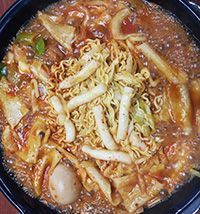
Tteokbokki at the restaurant opened by Ma Bok-rim, who created the Sindang-dong-style rice cake dish mixing black bean sauce with red chili pepper paste / Korea Times photo by Kim Ji-soo
Tteokbokki, or stir-fried spicy rice cake, is a ubiquitous snack in Korea. In particular, Sindang-dong style tteokbokki evokes memories of when this reporter in secondary-school uniform used to take the bus to the eastern Seoul neighborhood to sample the snack.
The stores were small and always humid because of the dish containing the rice cakes, noodles, fish cakes and vegetables cooked on burners at the table. Steamy, more stew-like and a bit exotic at that time, it was a big hit.
Now, the street where 10 such stores still survive has been designated as a Future Heritage by Seoul City.
The taste of the Sindang-dong-style tteokbokki is strangely familiar to the Korean palate and good enough to make people come back after years and even decades. This form of the snack is attributed to Ma Bok-rim, who happened to mix black bean sauce with red chili pepper paste. Her restaurant that opened in 1953 is still there at the entrance of the street. Similar restaurants opened in earnest in the 1980s. The queen of the snack passed away in 2011 but is now succeeded by her children and their spouses.
Place one skinny rice cake and wrap it around some noodles and chew, and the taste is a wonderful combination of sugar, red chili pepper paste and black bean sauce.
The Sindang-dong style itself differs from the better-known spicy chili pepper-based one. But then again, the tteokbokki comes in variations ranging from the “royal court” style in soybean sauce and beef to even tteokbokki in carbonara sauce.
The other shops next to Ma Bok-rim’s offer more varying dishes such as tteokbokki in black bean sauce and with seafood. Several restaurants offer other menus such as pig’s feet or rice. Some stores also have DJ booths. Park Chan-young, 53, owner of I Love Sindangdong, said he introduced the DJ and live music feature about 16 years ago to entice younger consumers and also to update the restaurant to the era.
“It was a huge success,” Park said. He said in the street’s heyday, Sunday sales at one large store could post as high as 20 million won, which he stressed is not the case anymore. I Love Sindangdong has seven “shareholders” who merged their smaller stores to survive in 2005.
Kim Young-shin, who has run Joojeom Tteokbokki for 29 years, said she is proud of her restaurant.
“The business is not like what it used to be,” she said. “Up until 2010, the business was good. I’ve raised my two children.”
But even in around 3 p.m., after-lunch hours, people kept straggling in, either by themselves or in groups.
The price of the menu begins from 6,000 won for one person, and goes up to 11,000 won for two through for five at 24,000 won. The stores are mostly open around the clock, taking turns each month to close at night.
For all the history and memories that Koreans have of this beloved snack, this alley near Dongdaemun Market is desolate. Amid the craze for redevelopment, one could not but wonder whether these shops will someday revamp to have a whole new decor and interior.
City officials said that the designation of Future Heritage is to promote a sense of pride for the residents and business owners and encourage self-preservation but that the street and its inhabitants are not inhibited from redeveloping.
Park believes that the stores could upgrade while the same time retaining their traditional allure with the steamy, almost soupy tteokbokki.
“If our facilities are too dilapidated, the business might not be sustainable. But the street will remain for sure,” Park said.
As for Kim, “I hope to be at it for a long time,” she said. “It is my retirement plan.”