People achieved political revolution with ballots
By Kim Se-jeong
“Revolution” is a word being used by political pundits to describe the results of the April 13 general election.
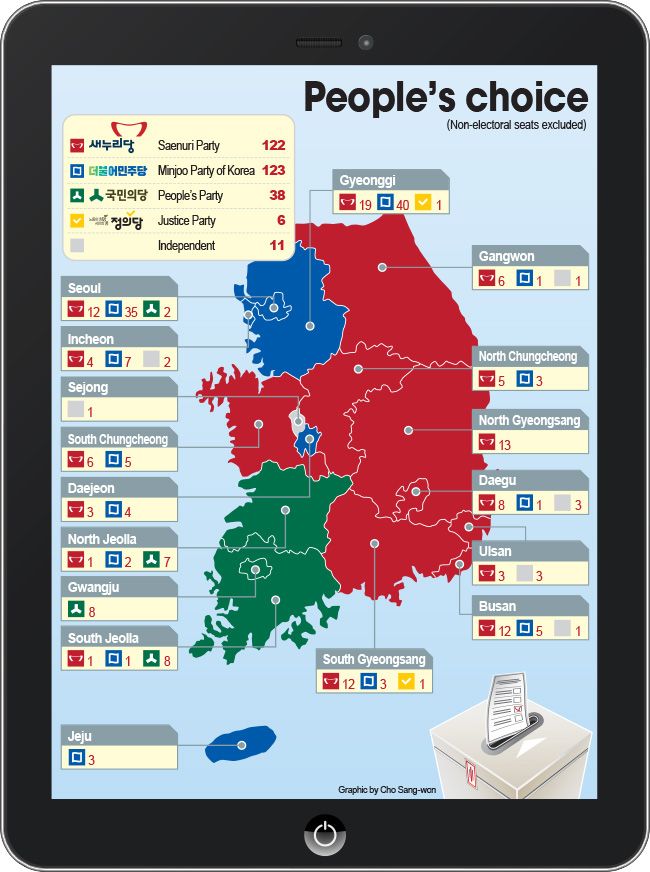
The conservative Saenuri Party took only 122 seats of the 300-seat National Assembly, conceding the role of majority party to the main opposition Minjoo Party of Korea (MPK) which won 123 seats.
Never before in Korean history has a ruling party lost its parliamentary majority while an affiliated president is still in office.
“I would call it a voter revolution,” Prof. Choi Chang-ryul from Yongin University told The Korea Times. “People were silent. But, they knew they wanted to topple the old ruling party and took that desire to the polling stations (instead of taking up arms).”
Hwang Tae-soon, a political commentator, echoed Choi. “I would quote a Chinese saying: ‘The sky coming down to the ground and the ground rising up to the sky.’ This is to emphasize how surprising the election result is. This never happened before in Korean politics.”
The ruling party suffered defeats in Seoul, Daegu and Busan by large margins. Instead, the MPK took the majority of seats in Seoul and won in a key district in Daegu, the Saenuri Party’s stronghold. The minor opposition People’s Party also gained 38 seats in total, a meaningful success.
People were united in warning the ruling party, according to Choi.
Many districts in Seoul had two candidates from the opposition, the MPK and the People’s Party, which should have worked to the advantage of the Saenuri Party.
“But voters united behind the opposition candidates,” Choi said.
Also many liberal voters gave support to the People’s Party for it to get proportional representation seats.
“What voters did at the polls was incredible,” Choi said.
But, both he and Hwang warned that it wasn’t the people’s genuine support of the opposition that produced the result.
“The opposition has nothing to brag about. It’s not that people voted for the opposition because they liked them,” Choi said.
Discontent for old politics from long-term conservative supporters was evident. “Some had no motivation to show their support. But they also didn’t feel comfortable voting for the opposition. So they gave up voting,” Hwang said. “That’s what happened in Daegu, for example.”
They said that the sluggish economy is believed to be the biggest reason for the Saenuri Party’s defeat. Taxation on consumer goods has risen under President Park Geun-hye. Unemployment among those under 30 reached 12.5 percent this year, and households are plagued by increasing debt. “The economy played a big role,” Hwang said.
But, it’s not just about the economy, according to Choi. “Park’s lack of leadership and communication skills and her meddling in party politics disgusted the people.”
Choi lauded voters in Daegu for giving a liberal candidate a chance. “Regionalism has been an important element in Korean politics, and what happened indicates this can improve.”
However, Hwang refuted Choi. “What happened in the Jeolla provinces is a clear sign that a political divide exists along border lines. This is not desirable. Voters need to be more mature.”