'Lame duck' woes hit ruling camp
By Kang Seung-woo
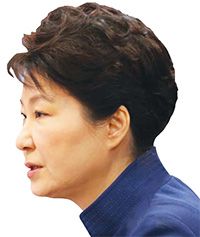
President Park Geun-hye
The ruling Saenuri Party’s crushing defeat in Wednesday’s general election may weaken President Park Geun-hye’s grip on power ― and possibly make her lame duck prematurely, analysts said Thursday.
The President tried to use Wednesday’s election as a springboard to maintain her grip on power during the remainder of her term. Park’s presidency ends in February 2018.
However, the election stripped the Saenuri Party of its parliamentary majority ― for the first time in 16 years ― and is likely to prevent Park from advancing her legislative agenda, hastening the arrival of the lame-duck session for her.
In addition, her “self-righteous” governing style will face a backlash from the ruling camp ― one of the reasons for a mass departure of the party’s traditional supporters.
“President Park may enter an early lame-duck phase,” said Hangil Research director Hong Hyeong-sik.
“The Saenuri’s defeat is due to the mass departure of its supporters to the opposition and Cheong Wa Dae’s behavior is the root cause for the defection.”
Since late last year, President Park has stressed the need to harshly criticize the opposition in the election for its non-cooperation in passing bills aimed at spurring the sluggish economy.
In addition, she repeatedly demanded the public’s selection of “sincere people” in the election ― referring to those loyal to her ― and her appeal was reflected in the Saenuri’s nomination process.
Despite her efforts, the Saenuri only took 122 seats in the 300-member National Assembly, and was demoted to the No. 2 party behind the main opposition Minjoo Party of Korea (MPK) with 123.
“Voters ― especially the party’s followers ― seem to have been frustrated by the undemocratic acts of the presidential office as well as of the ruling party during the nomination process,” Hong said.
An official of the former ruling party also said, “Older and conservative voters did not go to the polls aggressively because they were disappointed at President Park’s self-righteousness. It is a warning message to her.”
Such a backlash was even evident in Daegu ― President Park’s political stronghold ― with the Saenuri losing four out of the 12 Assembly seats there.
Park is also expected to lose her control of the former governing party due to the election defeat.
“The excessive intervention of President Park and her loyalists in the candidate nominations adversely affected the results, so the party may try to distance itself from the President and raise its own voice that is different from that of Cheong Wa Dae,” said Hong.
In order to break through the difficulties, President Park is advised to change her governing style into one of communicating with the public as well as opposition parties.
“President Park has urged the people to judge the National Assembly, but the result was completely opposite to what she wanted, meaning that she had unilaterally governed the country,” said Kim Hyung-joon, a professor of political science at Myongji University, in a media interview.
Hong also said, “President Park needs to set a new relationship with the opposition, recognizing it as a partner in leading the country. If she does not do that, there is no reason for the opposition to cooperate with her.”