Campaigning heats up in final stretch
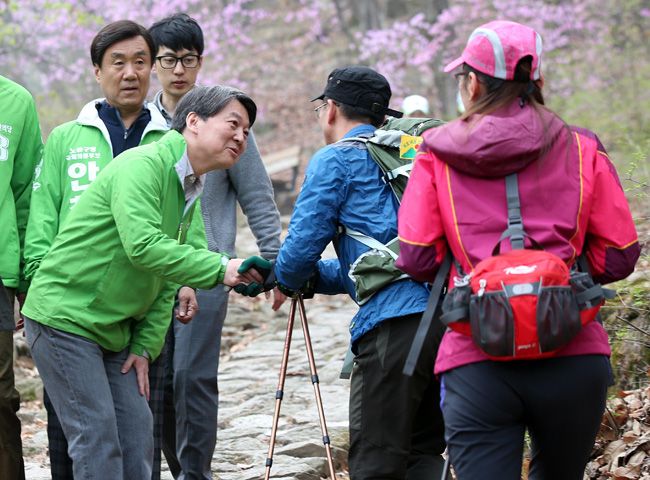
Rep. Ahn Cheol-soo, co-chairman of the minor opposition People’s Party, shakes hands with climbers at Mount Surak in Nowon, Seoul, Sunday, to appeal for support ahead of the April 13 general election. / Yonhap
Parties concentrate campaign efforts in and around Seoul
By Jun Ji-hye
Political parties pulled out all the stops while campaigning Sunday to try and win over voters in Seoul, Incheon and Gyeonggi Province, where 122 out of 253 electoral seats are up for grabs in the April 13 general election.
Pollsters say that these regions have larger numbers of swing voters and that races in more than 15 constituencies are too close to call. Swing voters account for some 20 percent of the total electorate within the districts.
The leaders of the ruling Saenuri Party, the main opposition Minjoo Party of Korea (MPK) and the minor opposition People’s Party visited these regions, appealing for votes for candidates from their respective parties.
The opposition parties emphasized that voters should judge the governing party and the President Park Geun-hye administration for “putting the nation’s economy into a crisis.” Meanwhile, the ruling party is arguing that the opposition parties dragged the economy down because they always disagreed with whatever the ruling party suggested.
.jpg?w=728)
Rep. Kim Moo-sung, chairman of the ruling Saenuri Party, gives a piggy back ride to the party’s candidate Byun Whan-bong, while assisting on the latter’s campaign at Sujeong in Seongnam, Gyeonggi Province.
Ruling party Chairman Rep. Kim Moo-sung made appearances at the campaigns of 11 candidates in his party that are standing in Gangdong, Songpa, Gangnam, Gwangjin, Dongdaemun and Seongdong.
MPK interim leader Kim Chong-in had an even tighter schedule, joining 18 candidates from his party in a one-day stumping at constituencies across Seoul and Gyeonggi Province.
Rep. Ahn Cheol-soo, co-chairman of the People’s Party, also visited Gwanak and Guro in Seoul to woo voters there. The other co-chairman of the minor opposition party, Chun Jung-bae, who has mostly carried out campaigning in Gwangju, a traditional home turf for liberal parties, came to the capital to support candidates running in the area.
The April 13 general election will decide who is to fill 253 directly elected and 47 proportional representation seats.
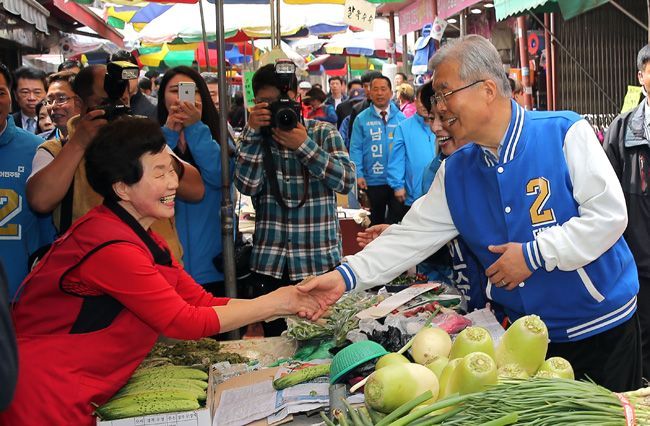
Kim Chong-in, interim chairman of the main opposition Minjoo Party of Korea, greets a merchant at a traditional market in Songpa, Seoul.
On Sunday, each party released forecasts of how many seats they expect to win. The ruling and main opposition parties were overly conservative about their predictions, while the minor opposition People’s Party was fairly optimistic.
The Saenuri Party expected to win about 145 seats, falling short of securing the majority. The MPK cautioned that it might end up winning fewer than 100 seats, while the People’s Party predicted it will grab as many as 35 seats.
According to analysis by four local pollsters, in the mean time, the ruling party is expected to secure 157 to 175 seats, the MPK 83 to 100 seats, and the People’s Party 28 to 32 seats.
Compared to a previous analyses conducted on March 13, the number of seats predicted for the MPK dropped, while that for the People’s Party increased. At the time, the MPK was expected to win 95 to 110 seats, and the People’s Party 10 to 20.
“If the MPK succeeds in putting up single candidates with the People’s Party in the capital area, it will be very helpful for the party,” an official of the pollsters told reporters on the condition of anonymity. “Eighty percent of voters seem to have already decided on whom they will vote for, while 20 percent still remain as swing voters. The greatest variable will be a turnout of voters in their 20s, 30s and 60 or beyond.”
Another official said, “The results in 10 to 15 constituencies in the capital area are changeable until the last minute.”
The MPK has been engaged in an uphill battle outside the Seoul metropolitan area as well, according to the pollsters, as it was expected that the main opposition party would win only five to seven seats to the ruling party’s 20 to 22 seats in the Chungcheong provinces, in which 27 seats are up for grab.
In the so-called Honam region that encompasses the MPK’s traditional stronghold of North and South Jeolla Provinces and Gwangju, the party was forecast to secure 8 to 11 seats, fewer than the People’s Party’s 17 to 20 seats.
The worst scenario for the governing party would be if it loses some 15 seats in the Yeongnam area to candidates of the MPK or the minor opposition Justice Party, or independent runners, the pollsters added.
Yeongnam refers to South and North Gyeongsang provinces, the bastion of the conservative party.
Meanwhile, some 5.13 million, or 12.19 percent, out of 42.1 million eligible voters cast their ballots during an early voting conducted Friday and Saturday ― the highest turnout since the early voting system was introduced in 2013, according to the National Election Commission.
The turnout of early voting for the local elections in June 2014 was 11.49 percent.
Follow Jun Ji-hye on Twitter @TheKopJihye