NK warned of harsh price for rocket plan
Beijing urges Pyongyang to act prudently
By Jun Ji-hye
The government warned North Korea, Wednesday, that it will pay a “harsh price” if it proceeds with its stated plan to launch a long-range rocket into space.
The warning came after Pyongyang notified the International Maritime Organization, Tuesday, of its intention to launch an Earth observation satellite called “Kwangmyongsong,” between Feb. 8 and 25.
The launch is widely believed to be a cover for testing an intercontinental ballistic missile (ICBM) with a range of approximately 13,000 kilometers. This means the missile, if successfully tested, could feasibly hit targets on the U.S. mainland.
The notification came almost a month after the North conducted a fourth nuclear test on Jan. 6.
Experts say that the technologies applied to the launch of long-range rockets and ICBMs are basically the same — the only differences are the payloads. If a rocket is loaded with a satellite, it becomes a space launch vehicle, and if loaded with a warhead, it becomes a missile.
The South Korean military strengthened its reconnaissance posture by increasing the number of the Navy’s Aegis destroyers deployed to two following the North’s notification. The Aegis is capable of tracking rocket trajectories.
Cho Tae-yong, deputy chief of the presidential national security office said that the notification, which comes at a time when the United Nations Security Council is discussing fresh sanctions against the North’s fourth nuclear test, is a clear provocation against the international community.
“If the North goes ahead with the launch, it will pose a serious threat to peace and stability in this region and the world. Then, the North will have to pay a harsh price,” he said.
The remarks came after Cheong Wa Dae held an emergency meeting of the National Security Council early in the morning.
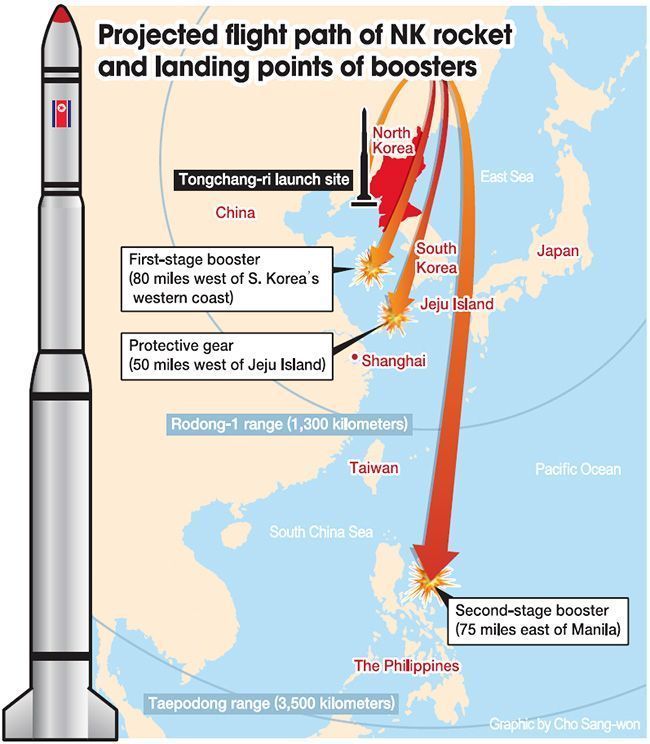
In a letter to the IMO, Pyongyang provided coordinates for three maritime areas where rocket stages are expected to fall. The first is expected to fall in the West Sea, the fairing in the East China Sea and the second stage in the Philippine Sea.
“It is my pleasure to inform you of the decision of the government of the Democratic People’s Republic of Korea (DPRK) to launch an Earth observation satellite ‘Kwangmyongsong’ pursuant to the national space development program,” Jon Ki-chol, director-general of the North’s Maritime Administration, stated in the letter.
Countries are required to give international organizations advance notice of rocket launches to warn planes and ships to stay away from the areas affected. The isolated state has done so in its previous rocket launches.
Pyongyang keeps arguing that its rocket launches are aimed at putting “peaceful satellites” into orbit, claiming that the peaceful use of space is the sovereign right of any nation.
However, Pyongyang is banned from undertaking such launches under U.N. Security Council resolutions because it is accused of using them as ICBM tests.
The Ministry of National Defense said it is coming up with countermeasures in the wake of the North’s announcement, including analysis of the possible timing of the launch and the areas to which the rocket parts are expected to fall.
One ministry official said, “The military is maintaining a heightened alert and is closely monitoring the North’s movements by mobilizing intelligence assets.”
For its part, China, traditionally an ally of the North, called on Pyongyang to act with prudence.
“North Korea of course has rights to use space, but it is currently under sanctions of the U.N. Security Council,” Lu Kang, spokesman of the Chinese Foreign Ministry, said during a media briefing.
Washington also said that the North’s planned satellite launch would violate numerous U.N. resolutions, stressing that the international community must impose “real consequences” on Pyongyang for its provocative actions.
“This latest announcement further underscores the need for the international community to send the North Koreans a swift, firm message that its disregard for U.N. Security Council resolutions will not be tolerated,” State Department spokesman John Kirby said at a regular briefing, Tuesday.
Separately, Japanese Defense Minister Gen Nakatani ordered Tokyo’s Self-Defense Forces to destroy the North Korean missile if it enters Japanese waters, land or airspace, according to the Japan’s Kyodo News.
The North is believed to be developing a nuclear warhead small enough to fit on its new KN-08 ICBM through a series of test launches with the latest one in December 2012, during which it fired the Unha-3 long-range rocket from its Sohae Satellite Launching Station in Tongchang-ri.
The Unha-3, which the North claimed put a satellite into orbit, is believed to have a range of more than 10,000 kilometers. The Defense Ministry’s 2014 White Paper stated that the 2012 launch was believed to be a test of an improved version of the Taepodong-2 long-range missile.
The North has conducted four nuclear tests in 2006, 2009, 2013 as well as the one last month.
Follow Jun Ji-hye on Twitter @TheKopJihye