Girl statue remains sticking point

Yoo Hee-nam, second from right, a former comfort woman, speaks during a press conference at the House of Sharing, a shelter for sexual slavery victims in Gwangju, Gyeonggi Province, Monday. They are opposed to the idea of relocating the comfort woman statue. / Korea Times photo by Seo Jae-hoon
By Kang Seung-woo
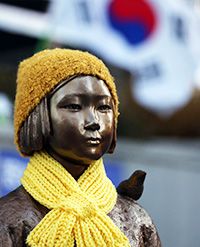
This photo shows the statue of a girl that symbolizes the Korean “comfort women” in front of the Japanese Embassy in central Seoul. The statue was placed there in 2011 as part of a protest against Japan's forced sexual slavery before and during World War II. / Yonhap
The statue symbolizing a Korean “comfort woman” in front of the Japanese Embassy in Seoul is expected to remain the main impediment for improving relations between Korea and Japan, despite a landmark deal signed by the two countries to resolve the issue, Monday.
Under the agreement, reached between Foreign Minister Yun Byung-se and his Japanese counterpart Fumio Kishida, the Korean government will begin consultations with civic groups over the possibility of relocating the statue located near the Japanese Embassy in Seoul.
However, civic groups representing the sex slavery victims are protesting the agreement, saying they will keep the statue there until Japan admits legal responsibility for the women.
This indicates that the statue could become a seed of conflict between the Korean government and the civic groups.
After the ministerial meeting, Kishida told Japanese reporters that the Japanese side believes that the Korean government will make efforts to move the statue.
The statue depicting an unsmiling young girl staring at the Japanese Embassy was erected in December 2011 by the Korean Council for the Women Drafted for Military Sexual Slavery by Japan. Currently, there are 24 statues in Korea, along with two in the United States. Calling for Japan’s resolution of the long-running thorny issue, a group of activists hosts a weekly rally every Wednesday around the statue across from the Japanese Embassy.
As for possible government consultations about relocating the statue, the survivors of Japanese sexual slavery said it is unreasonable.
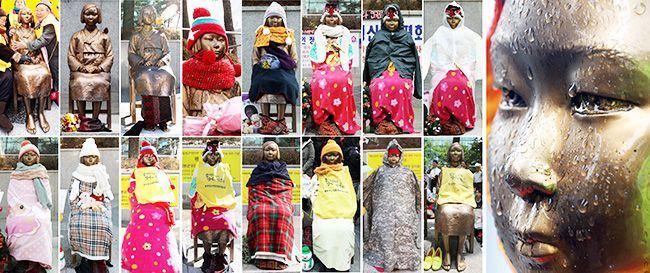
These photos show Statue of Girl in front of the Japanese Embassy in central Seoul. The statue was erected in 2011 as part of a protestagainst Japan’s forced sexual slavery before and during World War II. / Yonhap
In addition, the sculptor of the statue, Kim Woon-sung, said he would object if the government demands the removal of the statue.
“I was shocked to see the government say it will consult with civic groups to remove it,” said Kim.
“Rather than removing the statue in front of the embassy, we need to urge Japan to sincerely apologize for its wartime aggression by erecting more statues in Japan.”
He added that if the former comfort women agree to the removal of the statue, he would follow their decision.
Yoon Mee-hyang, one of the co-presidents of the Korean Council for the Women Drafted for Military Sexual Slavery by Japan, said, “The statue of the girl has become something like common property which our group cannot do anything about, and therefore it is impossible to bring it down or relocate it.”
She also slammed the Korean government for its secretive dealings in the negotiations with Japan, citing a report suggesting that Seoul may persuade local civic groups to remove the statue.
An organization encompassing groups of independence activists also insisted that the government not relocate the statue.
“According to media reports, the Korean government may convince the civic groups to accept the relocation plan, if its negotiations with Japan on the issue of wartime sexual slavery make progress. But the statue should be permanently preserved as a lesson of what should never be repeated,” the group said.
They likened Japan’s demand for the removal of the statue in front of its embassy to Germany urging Poland to bring down the Ghetto Heroes Monument to improve their bilateral ties.
“We want to witness Abe kneeling down before the statue as former West German Chancellor Willy Brandt did so before the monument,” the group said.
Sensitive about the statue, the Japanese have demanded that Korea relocate it during 12 rounds of working-level bilateral talks that have taken place since April 2014.
“The Abe Cabinet believes that the comfort woman statue is preventing Japan’s efforts to expand its role in the international community because the statue is giving Japan a bad reputation internationally,” said Park Won-gon, an international relations professor at Handong University.
Kim Yeoul-soo, an international relations professor at Sungshin Women’s University, said that the possible removal of the statue in front of the Japanese Embassy will lead to bringing down statues in the U.S., as well.
“If Korea and Japan agree on removing the statue, Japan will begin lobbying the U.S. for the removal of the monuments there,” Kim said.