'YS kids' dominating Korean politics

Ruling Saenuri Party Chairman Kim Moo-sung, center, floor leader Won Yoo-chul, left, and Supreme Council member Rhee In-je mourn the death of former President Kim Young-sam during a moment of silence at the National Assembly in Seoul, Monday. / Korea Times photo by Oh Dae-geun
By Yi Whan-woo
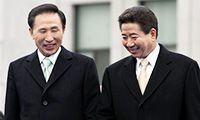
Former President Lee Myung-bak, left, and his predecessor Roh Moo-hyun stand together at Lee’s inauguration ceremony at the National Assembly in Seoul, in February 2008. / Korea Times
Late former President Kim Young-sam was acknowledged posthumously for his ability to unearth talented individuals that have become leaders in Korean politics.
Named after Kim Young-sam’s initials, the so-called “YS kids” include former and incumbent presidents, governors and leaders of political parties, regardless of their political orientation.
Ruling Saenuri Party Chairman Rep. Kim Moo-sung and Rep. Suh Chung-won, both of whom are Supreme Council members, have grown into key figures of Korean politics after beginning their political careers under Kim in 1985.
Back then, both Kim Moo-sung, 64, and Suh, 72, joined a committee set up by Kim, who was fighting military strongman Chun Doo-hwan.
Serving as president from 1993 to 1998, Kim Young-sam formally ended decades of military rule in Korea.
“I regard myself as a political son of Kim Young-sam and I’ll spare no efforts as a chief mourner,” the Saenuri Party chairman said Sunday.
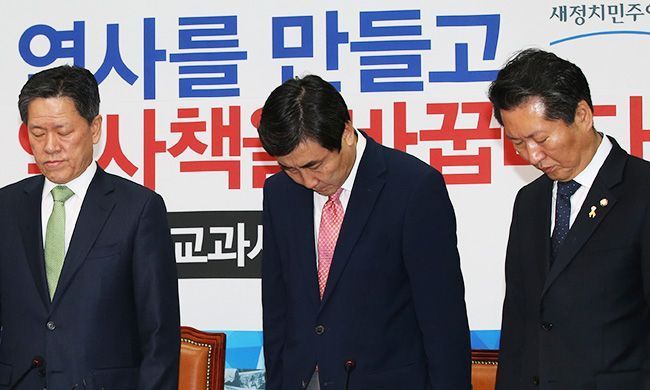
New Politics Alliance for Democracy floor leader Lee Jong-kul, center, and Supreme Council members Jung Cheong-rae, right, and Joo Seung-yong observe a moment of silence to honor former President Kim Young-sam, who died on Sunday, at the National Assembly in Seoul, Monday. / Korea Times photo by Oh Dae-geun
Former Presidents Roh Moo-hyun and Lee Myung-bak also entered the political ring with Kim Young-sam’s endorsement.
Roh, a former human rights lawyer who was head of state from 2003 to 2008, won a parliamentary seat in 1988 in Busan after Kim fielded Roh as a candidate of his party.
However, they parted ways after Kim decided to merge his party with two other parties affiliated with former military officials ― Roh Tae-woo, Park Tae-joon and Kim Jong-pil.
Kim Young-sam’s move was seen as a strategy to win the 1992 presidential election, but Roh criticized the move as a “betrayal of the democratic movement.”
Lee, 74, who was head of state from 2008 to 2013, became an entrepreneur-turned-lawmaker in 1992, when he won a parliamentary seat in the general election as a proportional representative of the Kim-led Democratic Liberal Party, one of the Saenuri Party’s predecessors.
National Assembly Speaker Chung Ui-hwa, Rep. Lee Jae-oh of the Saenuri Party, former Gyeonggi Governor Kim Moon-soo and Kim Ki-choon, former presidential chief of staff for President Park Geun-hye, won their first National Assembly seats in the 1996 general election.
In particular, then-President Kim Young-sam supported liberal Lee Jae-oh and Kim Moon-soo, even though Kim’s administration was conservatively oriented.
Kim Young-sam also brought three former presidential candidates ― Lee Hoi-chang, Sohn Hak-gyu and Rhee In-je ― to the political circle.