Ideological war starts over history textbooks
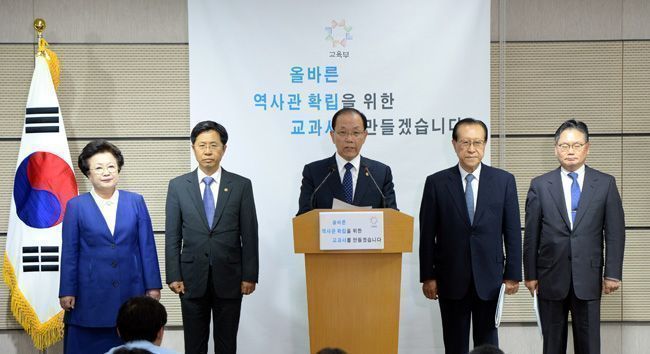
Education Minister Hwang Woo-yea, center, announces the government decision to monopolize the right to write a history textbook for secondary schools during a press conference at the Sejong Government Complex, Monday. / Korea Times photo by Seo Jae-hoon
Government will author single book
By Jung Min-ho
The government announced Monday that it will monopolize the right to author history textbooks for secondary schools, throwing the nation into an ideological war over how students should learn modern history.
Education Minister Hwang Woo-yea said the government’s decision to take back the publication rights from eight private publishing firms is aimed at “correcting left-leaning history textbooks.”
The government-backed National Institute of Korean History (NIKH) will soon start recruiting a team of up to 40 writers for the job. Hwang said it will take about one year to finish writing the new books. And starting in 2017, students will learn history from them.
“The current system has failed to provide a balanced view of historical issues, constantly causing ideological conflicts,” Hwang said in a media briefing at the Government Complex in Sejong. “Most textbooks contain distorted or exaggerated information and they encourage students to take a biased view of history.
“Under the current system, there is a fundamental limit on teaching students the correct history of Korea.”
Hwang said the new textbooks will be named “Accurate History Textbook.”
“The books will help the nation become united,” he insisted. “It is the government’s responsibility to correct what’s wrong in history textbooks.”
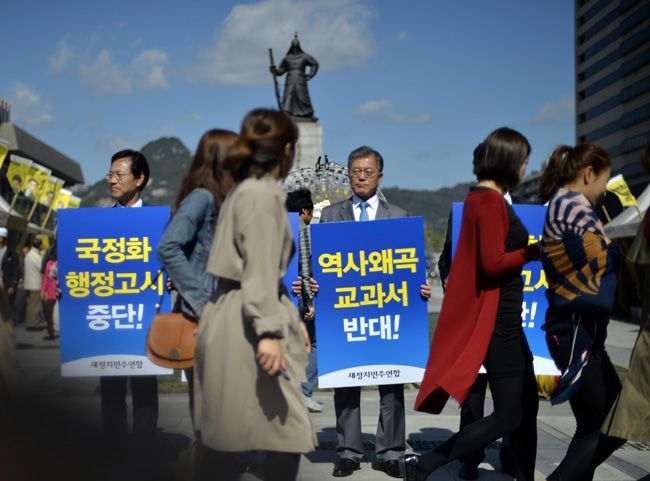
Lawmakers from the main opposition New Politics Alliance for Democracy, including Chairman Moon Jae-in, center, stage a protest against the decision at Gwanghwamun Square in central Seoul. / Korea Times photo by Shim Hyun-chul
But the decision is drawing fierce protests from opposition political parties, historians and educators.
They believe that the idea of a state-compiled textbook is part of the government’s effort to justify past military dictatorships and pro-Japanese activities, which they claim has enriched the ancestors of many of the current ruling class.
Hwang pledged that the ministry will ensure diverse views will be included in the new textbooks, saying that experts from many different backgrounds will participate in producing it.
However, the prospect of fulfilling his promise isn’t bright, with most liberal historians already refusing to be part of the project.
About 60,000 people, including the superintendents of regional education offices, professors and middle and high school teachers, have so far signed a petition against the plan. They plan to send the petition to Cheong Wa Dae.
They said what the government needs today is to give more — not less — freedom to textbook producers in terms of determining what content should be included in books.
Street protests from organizations, including the Korean Teachers and Educational Workers’ Union, a progressive teachers’ union, are expected to ensue.
President Park Geun-hye’s father, former President Park Chung-hee, introduced state-written textbooks in 1974, to justify his military dictatorship as a means to enabling rapid economic growth.
Until 2009, the government was in charge of publishing history textbooks. It began allowing approved private publishing companies to produce texts in 2010.
Only a handful of countries in the world use state-approved history textbooks. Among these are North Korea and Vietnam.