Park, party chief collide over nominations
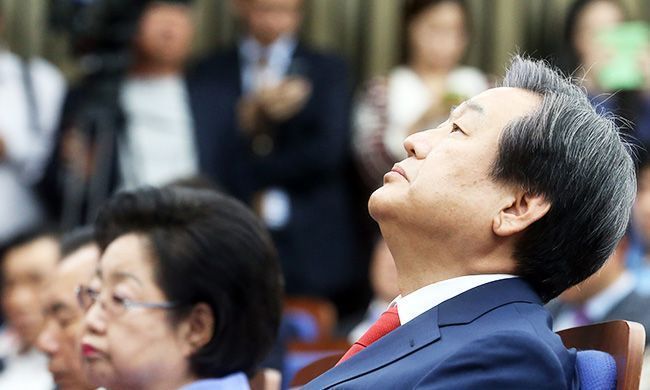
Saenuri Party Chairman Kim Moo-sung looks pensive during a party meeting at the National Assembly, Wednesday. / Yonhap
Internal conflict escalates in Saenuri Party
By Kim Hyo-jin
Cheong Wa Dae and ruling Saenuri Party Chairman Kim Moo-sung collided Wednesday over Kim’s move to overhaul candidate nomination procedures for the general election next year.
This represents a simmering conflict inside the ruling camp between loyalists to President Park Geun-hye and others led by Rep. Kim over how to choose candidates for the election.
A presidential aide criticized Kim over a deal he reached with the leader of the main opposition party last week to change the current nomination procedures.
The pro-Park faction claims the deal was politically motivated to weaken its influence on party affairs and prevent the President from intervening in selecting candidates.
“It was a poorly-made agreement as Kim failed to collect opinions from within the party beforehand,” said the presidential aide, asking not to be named.
Hours later, Kim hit back at the Park aide, saying his patience was running out with those who were challenging reform.
Kim said he would stick to the reform plan, saying the practices of “strategic nominations” of powerful politicians for fiercely-contested constituencies will not be condoned any more.
“As long as I’m in this position, there will be no strategic nominations,” he added. “A Cheong Wa Dae official insulted the ruling party chairman today. I will not stand for such rude behavior.”
Over the past few days, the pro-Park faction has bombarded Kim with criticism of his agreement with New Politics Alliance for Democracy (NPAD) Chairman Moon Jae-in to use public opinion polls in selecting candidates.
They denounced Kim for ignoring calls from inside the party to reform electoral rules, saying he gave in to the demands of the rival party.
The presidential aide raised questions over the efficacy of the proposed scheme, saying it was riddled with flaws. “It is worrisome because the newly-proposed procedure could possibly distort public opinion,” the official said.
“It will be also financially burdensome for the National Election Commission and could give an advantage to candidates with a better ability in mobilizing political resources.”
Asked if the remarks can be interpreted as Cheong Wa Dae barging into a party matter, the official answered, “I said this because the situation is worrisome.”
Another presidential aide joined in bashing the ruling party chief, saying, “Kim is trying to launch a coup through the candidate nominating process.”
The two leaders of the rival parties saw eye-to-eye, Sunday, on adopting a bottom-up nomination system based on a mobile phone survey.
It was viewed as Kim’s compromise in reforming the candidate-selecting process, as it is a modified version of the U.S.-style open primary system he has touted so far.
The proposed system was already endorsed by the NPAD’s Central Committee as its own nomination procedure earlier this month, which became the basis for the pro-Park faction’s criticism.
“There’s nothing to consult about with Cheong Wa Dae since it is simply a technical matter.” Kim said. “I wouldn’t put much weight on the negative mood over the issue.”
Amid growing tensions between the rival factions, the party convened a meeting Wednesday afternoon to discuss whether it should adopt the proposed change in nomination rules.
However, they failed to narrow differences, according to a spokesman.
Instead, the party decided to establish a special panel to discuss the selection procedure, he said.
Analysts said Rep. Kim is challenging Park’s influence in naming candidates for the upcoming general election by pushing for the bottom-up nomination process.
“Ostensibly, they bicker over the efficacy of the system. But in truth, it’s a power game over who will have more influence in putting up candidates for the elections,” said Hwang Tae-soon, a political analyst at Wisdom Center.
“If the new system is implemented, incumbent lawmakers are likely to be elected — 99 percent for sure,” he said, noting that lawmakers of the non-Park faction have a higher ratio in the National Assembly.
“By giving the right to choose candidates back to the public, Kim, the leader of the non-Park faction can maintain his power.”
Yoon Tae-gon, a political analyst at Moa Agenda Strategy echoed a similar view, saying the tentative bipartisan agreement was Kim’s bid for victory in a battle with Park and her loyalists.
“Kim’s justification here is very clear,” he said. “It is about allowing ordinary citizens to participate in the candidate-nominating process, while the pro-Park faction just argues against the plan without presenting any alternative.
“Pushing for the plan could’ve been pre-meditated by Kim, who is aiming at gaining more power for the non-Park faction.”
There has been speculation that Park would exert influence in naming candidates to run in the general election in her home turf — Daegu and North Gyeongsang Province.
Rumors have been rife that senior officials at Cheong Wa Dae would run in the elections after resigning their posts.
Kim and Moon concurred as part of their agreement that the registration period for new politicians should be extended to six months prior to the election, Yoon said.
“This is a big hurdle for Parks’ aides because the registration period would start from late this month which will be too early for them to announce a bid to run in the election.” he added.